POLYNESIAN CHICKEN & ITALIAN FARRO & GORGONZOLA GARLIC DIPPING SAUCE

I also love to research foods we’ve never tried before as well as try old, old recipes or just plain make things up.  I also take requests if anyone would like me to test out a recipe for them.
Today we’re making Polynesian chicken (the cheating way) and Italian Farro with Gorgonzola garlic dipping sauce.  I saw a package of Pedon Italian Farro  at the grocery store the other day and it looked interesting (reminded me of rich looking barley) – so the impulse buy won and here we are.
Here’s the history lesson first:  Grano Farro has a long and glorious history: it is the original grain from which all others derive, and fed the Mediterranean and Near Eastern populations for thousands of years; somewhat more recently it was the standard ration of the Roman Legions that expanded throughout the Western World. Ground into a paste and cooked, it was also the primary ingredient in puls, the polenta eaten for centuries by the Roman poor. Important as it was, however, it was difficult to work and produced low yields. In the centuries following the fall of the Empire, higher-yielding grains were developed and farro’s cultivation dwindled: By the turn of the century in Italy there were a few hundreds of acres of fields scattered over the regions of Lazio, Umbria, the Marches and Tuscany.

Farro would probably still be an extremely local specialty had the farmers of the French Haute Savoie not begun to supply it to elegant restaurants that used it in hearty vegetable soups and other dishes. Their success sparked renewed interest in farro among gastronomes, and now the grain is enjoying a resurgence in popularity in Italy as well, especially among trendy health-conscious cooks.  

POLYNESIAN CHICKEN
4 Boneless, Skinless chicken breasts
1 stick butter, divided in half
1 cup Frank’s Sweet Chili hot sauce
1 package Knorr Vegetable Soup Mix
1/4 cup flour
  • Preheat oven to 350 degrees.
  • Using a small food processor,  grind the Knorr soup mix into a fine dust.
  • Add the vegetable soup dust to the flour in a large plastic bag and mix well.
  • Dredge chicken breasts in soup and flour mixture.
  • In a large skillet over medium high heat, melt one half of the butter.
  • While that is melting, melt the remaining butter in a 2 cup measuring cup in the microwave.
  • Add the hot sauce to the measuring cup and heat an additional 20 seconds. Mix well. Set aside to cool.
  • In the skillet brown the chicken breasts on both sides until almost done. 
  • Spray a small cookie sheet with PURE.
  • Coat each piece of chicken with hot sauce mixture and lay on cookie sheet.
ITALIAN FARRO

small bag PEDON farro

2 tablespoons Frank’s Sweet Chili hot sauce
  • Bring a 2 quart pan of water to a boil.
  • Add the Farro and simmer, 10-12 minutes.
  • Drain thoroughly.
  • Add hot sauce and toss to coat.
  • Serve immediately.

GORGONZOLA GARLIC DIPPING SAUCE
1/4 cup gorgonzola crumbles
1/3 cup mayonnaise
3 cloves garlic
2 tablespoons buttermilk
salt and pepper to taste
  • In a small food processor, process the crumbles until finely ground.
  • Add garlic, mayonnaise, salt and pepper.  Mix until well blended.
  • Add buttermilk.  Add a bit more if you would like a thinner sauce.

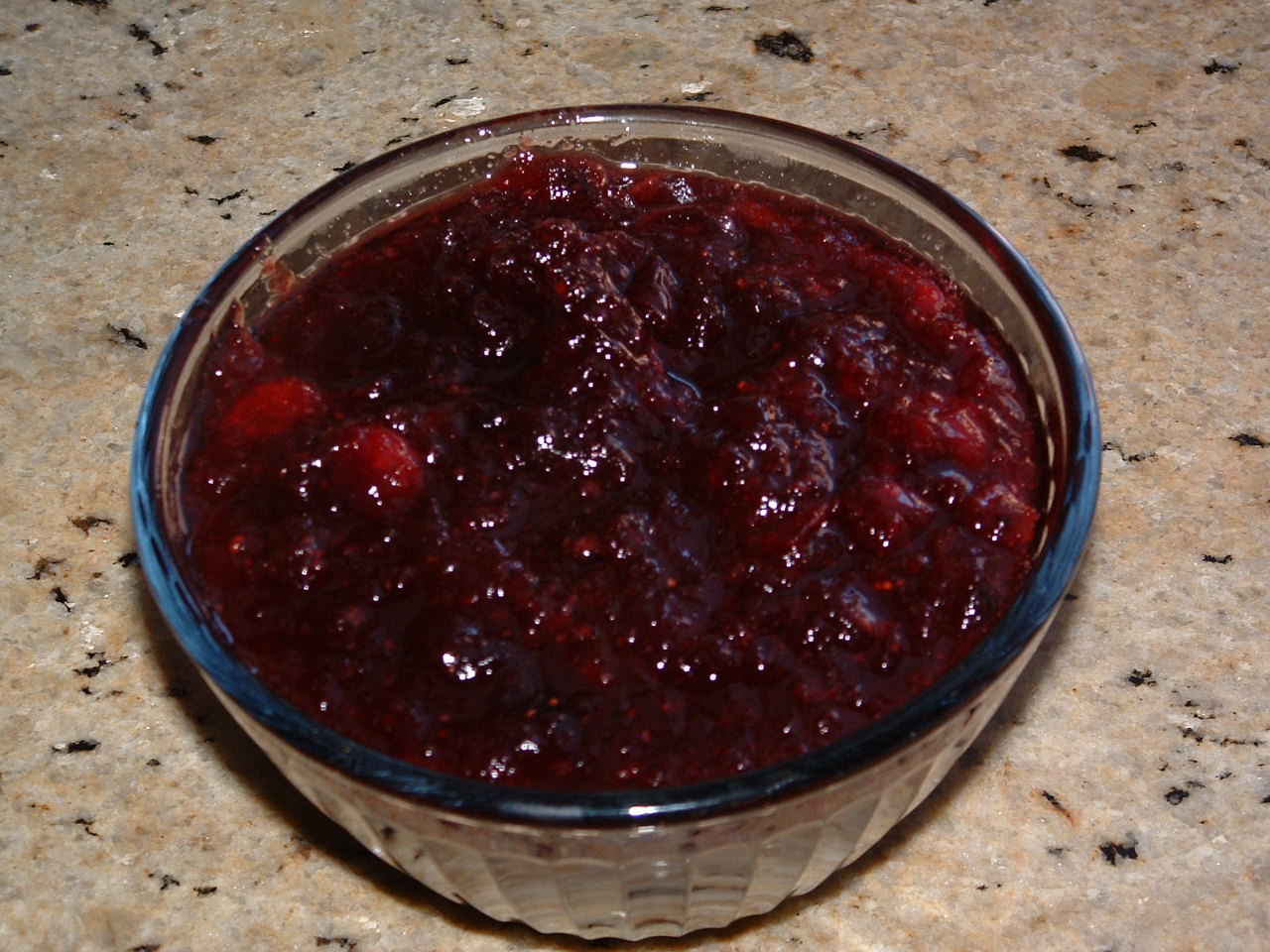
HOMEMADE CRANBERRY SAUCE

CRANBERRY SAUCE
1/2 cup orange juice with pulp*
1/2 cup pineapple juice*
1 bag cranberries
2 cups sugar
¼ teaspoon cinnamon
1 teaspoon orange peel
  • Wash cranberries and drain in colander. 
  • Mix orange juice and sugar in saucepan until dissolved. 
  • Add cinnamon and orange peel. Stir well.
  • Add the cranberries and simmer over medium high heat until bubbling, stirring often. 
  • When the mixture begins to boil, reduce heat. 
  • Cook uncovered or until all cranberries have ’popped’. 
  • Sauce will thicken as it cools. 
  • Can be stored in the refrigerator for a week or frozen for future holidays.

Yields: 2 cups
*You can use ALL orange juice if you prefer

***I like to make a double batch at Thanksgiving and freeze half for Christmas.

Missing the Lazy, Crazy days of summer… already

I don’t know about you, but I already miss summer and the taste of salads.  I’m usually at home already threatened with snow, but this year I’m helping out family way south of home and have the luxury of still getting some great vegetables and making some of our favorite salads and homemade dressings.

1 large wedge romaine lettuce, torn into bite size pieces
2 Roma tomatoes, sliced
1 small avocado, sliced
2 kiwis, skinned and sliced
1 small red onion, chopped
1 orange peeled, segmented and halved again

1/3 cup peanut oil
1/3 cup olive oil
6 tablespoons champagne vinegar
Juice of 1 lemon
Juice of 1 lime
6 tablespoons sugar
salt & pepper to taste

  • Whisk together peanut oil, olive oil, champagne vinegar, lemon juice, lime juice, sugar, salt & pepper. Chill for several hours.
  • Prepare veggies and toss well.
  • Drizzle salad all over and toss again.
  • Enjoy!
  • This makes enough dressing for 3 large salads.

SWEDISH MEATLOAF

MEATLOAF  
1 Jumbo egg
1/4 cup heavy cream
1 large slice white bread, crusts removed, and bread torn into 1-inch pieces
8 ounces ground pork, double ground

8 ounces ground beef, double ground
1 medium onion, grated or minced
1/8 teaspoon freshly grated nutmeg
1/8 teaspoon ground allspice
1/8 teaspoon white pepper
1 teaspoon brown sugar
1 1/2 teaspoons table salt
Olive Oil, heavy coat

  • Whisk egg and cream together in small bowl. Stir in bread and set aside to soak.
  • Blend hamburger & pork, onion, nutmeg, allspice, pepper, brown sugar, and salt smooth and uniform.
  • Using fork, mash bread mixture until no large dry bread chunks remain.
  • Add mixture to beef mixture and blend until well mixed.
  • Form meat loaves.  
  • Bake 45-60 minutes. 
  • During the last 10-15 minutes prepare the sauce.

SAUCE
1 tablespoon butter
1 tablespoon all-purpose flour
1 1/2 cups chicken broth
1 tablespoon packed brown sugar
1/2 cup heavy cream
2 teaspoons juice from 1 lemon
Table salt and freshly ground black pepper

  • Melt butter, add flour and cook, stirring constantly with whisk, until flour is light brown.
  • Slowly whisk in broth.
  • Add brown sugar and bring to simmer.
  • Reduce heat to medium and cook until sauce is reduced to about 1 cup, about 5 minutes.
  • Stir in cream and return to simmer.
  • Add meatballs back to sauce and simmer, turning occasionally, until heated through, about 5 minutes.
  • Stir in lemon juice; season with salt and pepper to taste and serve over noodles.

ARTICHOKE HEART VINAIGRETTE

I can see the headlines now, A YUMMY FIND at the thrift store yields great recipes!  Now I have modernized them to my family’s likes, but they were pretty good to begin with.

ARTICHOKE HEART VINAIGRETTE
1 can (1 lb) artichoke hearts 9 ounce baby artichoke hearts
1/3 cup white vinegar champagne vinegar
2/3 cup salad oil 1/2 cup light olive oil
1/4 teaspoon salt 1/2 teaspoon sea salt
dash pepper 1/2 teaspoon white pepper
1 tablespoon parsley
1 2 green onions, thinly sliced
  • Drain artichoke hearts.
  • Combine remaining ingredients and shake until well blended.
  • Puree’ artichoke hearts.
  • Pour over artichoke hearts, cover and place in refrigerator to marinate several hours
  • Add all other ingredients and puree’ until well blended. 
  • Chill.

aprons 3

PINEAPPLE VINAIGRETTE

These days you can get vinegars in a multitude of flavors.  Each new flavor opens the door for more and more possibilities.  We love this recipe when we’re craving a tropical edge.

1/3 cup peanut oil
3 tablespoons pineapple vinegar
Juice of 1 lemon
1 tablespoon sugar
salt and pepper to taste
1 green onion, minced
  • Mix together well.
  • Chill overnight.

CRAB LOUIE with OOMPH!


I bolded the OOMPH ingredients that are
different from my day to day recipe.

CRAB SALAD & HOMEMADE 1000 ISLAND DRESSING
CRAB SALAD
8 ounces Louis Kemp Crab, finely chopped
1 stalk celery, finely chopped
1/3 cup minced green onion
salt and pepper
mayo (about 1/4 cup)
1 teaspoon Frank’s Red Hot Pepper Sauce
Romaine lettuce
Roma tomatoes, sliced
Snap peas, halved
pickled beets, sliced
hard boiled eggs, sliced

  • Wash lettuce, peas and tomatoes. Arrange on plate. Salt and pepper.
  • Mix crab, celery, onion, hot sauce, salt and pepper together until well blended using enough mayonnaise for desired consistency.
  • Place a large scoop of crab salad over the romaine mix.
  • Serve over chopped romaine lettuce, sliced tomatoes and snap peas.
  • Top with dressing.

1000 ISLAND DRESSING
1/2 cup mayonnaise
2 tablespoons ketchup
1 tablespoon white balsamic vinegar
2 teaspoons sugar
3 teaspoons sweet pickle relish
1 heaping tablespoon minced red onion
1 teaspoon Worcestershire sauce
salt and pepper

  • In a mini blender blend all ingredients to desired consistency.
aprons 3

PEANUT BUTTER FEATHER PANCAKES & HOMEMADE MAPLE SYRUP

Peanut Butter Feather Pancakes
1 cup flour
2 tablespoons sugar
2 tablespoons baking powder
1/2 teaspoon salt
1 large egg
1/3 cup JIF Peanut Butter
1 cup milk
1 tablespoon butter, melted

  • In a large mixing bowl, sift together the flour, sugar, baking powder and salt.
  • In a small bowl, beat egg with Jif until blended. Stir in milk and melted butter.
  • Add all at once to the dry ingredients, beating until blended. Add more milk to thin batter if necessary.
  • Bake on a hot, lightly greased griddle until bubbles break on the surface. Turn and brown the other side.

Maple Syrup
1 cup white sugar
1 cup light corn syrup
1 cup dark brown sugar, packed
scant 1 cup water
1 teaspoon PURE vanilla extract
2 tablespoons maple extract

  • Combine all ingredients in a medium saucepan.
  • Bring to a slow boil.
  • Simmer gently 5 minutes.
  • Remove from heat and cool 5 minutes.
  • Store in refrigerator.

aprons 3

KETCHUP VS. CATSUP?

Do you ever wonder why we have both names or how they originated. Recently hubby has been requesting my 1000 Island dressing a lot which recently sparked an animated conversation on ketchup vs. catsup when I was a bit tired and my mid-western inflection sounded odd to his west coast ears. I decided it was time to put an end to the debate and started researching both names.

What I thought was going to be a simple research turned into an in depth history study. Here is what I found.

According to Culinary Sleuth the difference is primarily in the spelling and pronunciation, but I found that may not truly be the case. They claim it is America’s most widely used condiment and can be found in 97% of all kitchens.

The basic ingredients in today’s ketchup are tomatoes, vinegar, sugar, salt, allspice, cloves and cinnamon. Onions, celery and other vegetables are frequent additions. Catsup may be made of tomatoes, onions, cayenne, sugar, white vinegar, cloves, cinnamon, celery seed and salt. So the two do not differ much except that catsup appears to be spicier than Ketchup.

Per this site, “catsup is known to most experts to use higher quality tomatoes. This fact is not known to most consumers, and they blindly purchase the inferior ketchup more often”.

All versions seem to attribute the origins to an Asian, Chinese or Indonesian spicy pickled fish sauce that was predominantly a soy and Worcestershire based sauce that sometimes also had anchovies and dates back to the 1600’s. English Sailors brought ke-tsiap home with them from their voyages where the name was changed and finally became ketchup. It wasn’t until the late 1700s though that New Englanders added tomatoes to the blend. Henry J. Heinz began making ketchup in 1876 but he was neither the inventor nor the first to bottle it. His recipe remains the same to this day.

During my search I also found the Brooks Catsup of Collinsville Illinois which is home to the world’s largest bottle of catsup that doubles as the town’s water tower. It was saved in recent years by a preservation society and restored to it’s original appearance. This product is owned by Bird’s Eye in today’s world and is produced in limited quantity.

I also found this interesting parody on catsup v. ketchup, or at least I hope it is a parody. LOL
aprons 3

CREAMY SWEET & SOUR BACON DRESSING

BOILED SALAD DRESSING
now known as Creamy Sweet and Sour Bacon Dressing


2 egg yolks
2 tablespoons flour
1 teaspoon salt
1 teaspoon mustard
1/4 teaspoon paprika
1/2 teaspoon butter

1/3 cup vinegar
1/3 cup water
2 tablespoons sugar
4 slices bacon, crumbled small

  • Beat egg yolk thoroughly.
  • Sift dry ingredients together and add to the egg yolk mixture, mixing well.
  • Gradually and alternately add the vinegar and water.
  • Cook in double boiler until thick and creamy. Can be cooked directly over flame, but must be watched carefully and stirred constantly.
  • Add butter, beating smooth.
  • Remove from heat.
  • Add bacon pieces.
  • Store in refrigerator.

Recipe (page 106) adapted from ‘A Thousand Ways to Please a Husband’ by Louise Bennett Weaver and Helen Cowles LeCron
aprons 3

Hamburger Steaks with Parmesan Potatoes and Onion Gravy


HAMBURGER STEAKS
1 pound ground chuck
1 pound hamburger
1 sleeve Keebler club crackers, crushed
1/2 teaspoon sea salt
1/2 teaspoon white pepper
1 tablespoon Worcestershire sauce
2 cloves minced garlic
1/2 cup finely chopped onion
2 Jumbo eggs
1 tablespoon liquid Smoke – MYSTERY ingredient
PARMESAN MASHED POTATOES
6 medium red potatoes, washed and cut into pieces
1/4 cup sour cream
1/4 cup butter
1/4 cup Parmesan cheese
1/4-1/2 cup Buttermilk
ONION GRAVY
3 tablespoons butter
1/2 cup finely chopped onion
2 tablespoons self-rising flour
1 tablespoons cream sherry
2 cups hot water
1 tablespoon better than bouillon beef base
1 teaspoon Kitchen Bouquet
salt and pepper to taste

  • Combine all the hamburger steak ingredients until well mixed. Form six steaks.
  • Bake 30 minutes in convection oven at 350 degrees.
  • In a large skillet melt the butter for the gravy. Saute the onions until browned.
  • Add the bouillon base, cream sherry and hot water. Bring to a boil.
  • Reduce heat, add flour and continue cooking to desired consistency.
  • Bring potatoes to a boil until tender. Drain.
  • Combine potato ingredients and beat until smooth.
  • Enjoy

aprons 3

SAUCES & REDUCTION SAUCE SPELLED OUT

Sauces typically consist of a flavorful liquid such as stocks, milk, cream, vegetable purees or butter and a thickener, an ingredient or combination of ingredients that gives the sauce a thicker consistency such as:

  • Roux ~ which is equal parts fat and flour combined together over a low heat until a consistent paste is formed
  • Cornstarch ~ a fine, white powder made from the ground starch removed from corn
  • Arrowroot ~ is similar to cornstarch but made from ground plant roots
  • Liaison ~ a mixture of egg yolks and heavy cream, whisked together and carefully incorporated into a warm sauce.

The Five Classic French Mother Sauces are:

  • Béchamel – is a rich, creamy, smooth white sauce with a subtle onion flavor made by simmering an onion studded with whole cloves in milk and then adding the infused milk, minus the onion, to a white sauce.
  • Velouté – a rich, smooth, light colored sauce made by thickening chicken, veal or fish stock with roux.
  • Espagnole – full-bodied sauce made by adding brown roux, pureed tomatoes and mirepoix (combination of onions, carrots and celery) to brown stock; usually used to make demi-glace.
  • Tomato – traditionally made by adding a roux to tomatoes, vegetables and stock.
  • Hollandaise – a smooth, buttery, pale yellow sauce made by whisking melted butter into a mixture of egg yolks, lemon juice or vinegar. Hollandaise sauce is the only mother sauce served as is.

In ‘classical’ French cooking, sauces are a defining characteristic of French cuisine.

In the 19th century, the chef Antonin Carême classified sauces into four families, each of which was based on a mother sauce which are also called grandes sauces. Carême’s four mother sauces were:

  • Béchamel, based on milk, thickened with a white roux.
  • Espagnole, based on brown stock (usually veal), thickened with a brown roux.
  • Velouté, based on a white stock, thickened with a blonde roux.
  • Allemande, based on velouté sauce, is thickened with egg yolks and heavy cream.

In the early 20th century, the chef Auguste Escoffier updated the classification, adding sauces such as tomato sauce, butter sauces and emulsified sauces such as Mayonnaise and Hollandaise.

A sauce which is derived from one of the mother sauces is sometimes called a small sauce, or secondary sauce. Most sauces commonly used in classical cuisine are small sauces, or derivatives of one of the above mentioned mother sauces.

Mother sauces are not commonly served as they are, but are augmented with additional ingredients to make small or derivative sauces. For example, Bechamel can be made into Mornay by the addition of Gruyère or any cheese one may like, and Espagnole becomes Bordelaise with the addition and reduction of red wine, shallots, and poached beef marrow.

To make a reduction sauce, start by preparing the meat as you normally would. Remove the meat from the pan and allowed to rest while you make the sauce. Remove the excess fat so that the sauce will not be greasy. Increase the volume of the pan drippings by adding stock, cream, wine, balsamic vinegar, or meat juices.

Allowed the sauce to simmer so that it reduces in volume. This reduction makes the sauce dense and thick, so that it can be used like a gravy. It also concentrates the flavors. As a result, reduction sauces are often very strongly flavored, and most cooks use only a little bit, so that the flavor does not becomes overwhelming. Reduction sauce can be poured over meat like a gravy, or arranged as a visual appeal on the plate.

Often the sauce is pressed through a sieve to clarify out chunks of vegetables or meat parts. Often it is paired with other sauces or flavorings and each person can layer the flavors as desired.

aprons 3