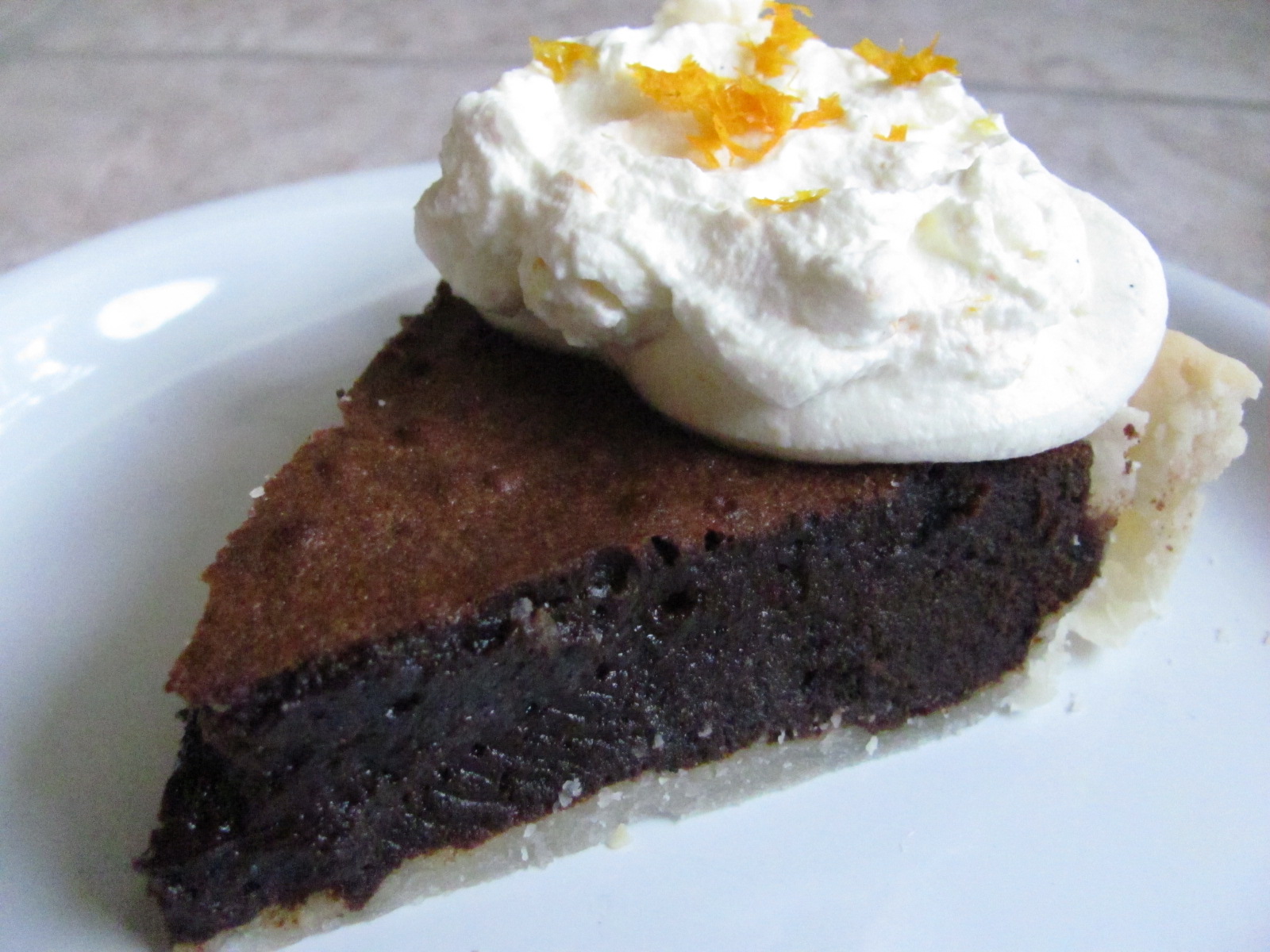
Save Room for Dessert…Cinnamon Mocha Pie with Orange Essence Whipped Cream

Last week, I took the non-chocolate route with raspberry pecan crumble bars.  So, I definitely thought it was time for chocolate again, yes?  The recipe is from Christmas with Southern Living 2003.  This pie has always been one of my favorites, as I adore all things chocolate, and with the addition of coffee and whipped cream, well, it’s a win-win!  My little twist is the orange flavor added to the whipped cream; it’s certainly optional, but oh so delicious! This pie is sheer indulgence.  There is no other way to describe it.  Dense with fudgey chocolate flavor.  Heady with the fragrance of cinnamon.  Luxuriously sinful with a dollop of whipped cream that’s just kissed with a hint of orange.  And, best of all, deceptively simple…enjoy!

Cinnamon Mocha Pie
1/2 cup unsalted butter
1 tablespoon instant coffee
2 oz unsweetened chocolate squares, chopped
2 oz semi-sweet chocolate squares, chopped
3 large eggs
3/4 cup granulated sugar
1/4 cup brown sugar
1 teaspoon vanilla extract
1/3 cup flour
1 tablespoon ground cinnamon
1 recipe all butter pastry, fitted into 9″ pie pan
1 cup whipping cream
1 tablespoon orange zest, plus extra for garnish
1 tablespoons orange juice
2 tablespoons powdered sugar

Prepare pastry and place pan into freezer while you prepare the filling.
Preheat oven to 350 degrees.
In a small saucepan over medium-low heat, melt butter and add instant coffee.  Stir in the chopped chocolate and continue to stir until chocolate is melted and the mixture is smooth.  Remove from heat, set aside, and allow to cool.
In another bowl, beat eggs and sugars until slightly frothy.  Add cooled chocolate and vanilla.  Stir in flour and cinnamon.  Pour mixture into prepared pie shell.
Bake at 350 degrees for 25 minutes or until filling sets.  Allow pie to cool to room temperature (the pie will cut better) and serve with whipped cream and a dusting of orange zest.

Whipped Cream with Orange Essence
Whip cream until soft peaks form.
Add 1 tablespoon zest, juice, and powdered sugar.
Continue to beat until firm peaks form.
Use immediately.

Adapted from Christmas with Southern Living 2003

CHICKEN MARSALA

Chicken Marsala

  • 1/4 cup all-purpose flour
  • 1/2 teaspoon sea salt
  • 1/4 teaspoon ground white pepper
  • 1/2 teaspoon dried oregano
  • 4 skinless, boneless chicken breast halves – pounded 1/4 inch thick
  • 4 tablespoons butter
  • 4 tablespoons olive oil
  • 1 small white onion, sliced into thin rings and then separated
  • 1/2 pound mushrooms, sliced thin
  • 1 tablespoon lemon juice
  • 1/2 cup Marsala wine
  • 1/4 cup sweet cooking sherry
  1. With a mortar and pestle grind the oregano. 
  2. Sift together the flour, salt, pepper and oregano. 
  3. Coat the chicken pieces well with the flour mixture.
  4. In a heavy skillet, heat oil and butter.  
  5. When oil and butter is hot, saute’ onions and mushrooms until just caramelized. 
  6. Set aside onions and mushrooms and place chicken breasts in skillet and brown on both sides about 6 minutes per side over medium heat. Remove and set aside, but keep warm.
  7. To the skillet, add the wine, lemon juice and sherry. Stir, reduce heat, and cook for about 10 minutes until the sauce is partially reduced and begins to thicken.
  8. Return onions and mushrooms to the skillet. 
  9. Plate chicken breasts.
  10. Spoon sauce over the chicken.
  11. Cover and cook over low heat for about 5-10 minutes or until chicken is done.

aprons 3

ARE YOU READY FOR SOME FOOTBALL????????????

We are – we’re HUGE fans!  We do a count down in August to pre-season every year and never miss a game when at all humanly possible!  Well, it’s that time of year again! Football season is already 1 week old and that means it’s time for tailgating at the games, serious football food and game day buffets.  Bring over your best appetizers and your biggest appetite and oh don’t forget the Brewskis to go with it all.  I like mine really cold please with a side of lime!
Tailgating Time will be posted every Sunday at noon and open all week for you to add your football favorites. We’ll play each and every week until Superbowl Sunday. I can’t wait to see what you’ll be bringing!
It’s Tailgating Time!
HOSTED BY:
Martha at Seaside Simplicity 
Tamy at 3 sides of Crazy 
Lyndsey at Tiny Skillet
Would you like to be a host of Tailgating Time too? 
Leave me a comment here with your email or with Martha over at Seaside Simplicity so we can send you the code and add you to the host list – more exposure, more links, more football food!
And don’t forget today is the last day to enter the $55 CSN giveaway here at 3 Sides of Crazy.  
Today is the first day to enter the $65 CSN giveaway over at Seaside Simplicity.  You  have to go to http://www.allcoffeetables.com/ and then come back either here or over at Seaside Simplicity and leave a comment saying which one is your favorite AND then link up a recipe to Tailgating Times. You are only eligible to win if you do both.  The winner will be announced at next week’s tailgating time.

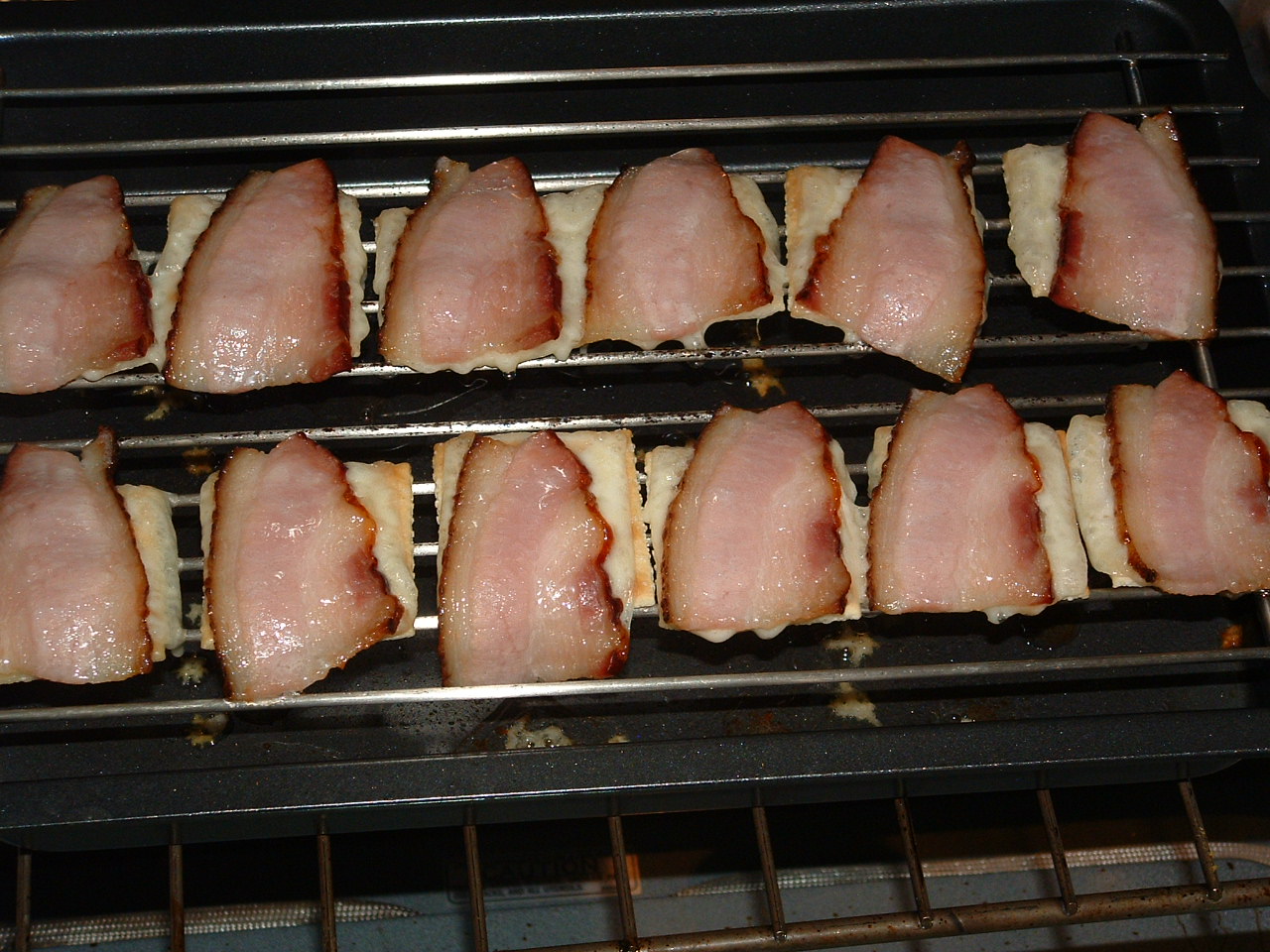
SALTY BACON CRISPS ~ Perfect Football Food Snacks

SALTY BACON CRISPS
12 bacon strips, cut in half*
6 slices Havarti or aged white American cheese, cut into quarters
24 saltine crackers
  • Top each cracker with a slice of cheese.
  • Wrap each cracker with a half strip of bacon.
  • Place on a cookie rack over a shallow drip pan.
  • *Bake 12 to 15 minutes, turning once, at 400° F.
  • Serve hot.

*I used thick bacon today and quartered each slice.  Then I laid it just on top and I prefer this I think.  Thick bacon does alter the bacon time to 15-20 minutes. 

They were soooooooooooo easy and tasty too.  The crackers soften up and absorb the cheese and bacon flavors.  Let them cool just a bit and they are perfect!

    WEEKLY MENU

    Menu Plan Monday hosted by Laura at I’m an Organizing Junkie

    DATE breakfast lunch supper
    MON 9/20


    CHICKEN SPAGHETTI
    TUES
    9/21

    RECIPE EXPERIMENT NIGHT ~ REDNECK CUPCAKES WAR ~ BBQ CHICKEN CHILE CORNBREAD REDNECK MUFFINS
    WED 9/22

    chinese chicken salad
    THU
    9/23

    chicken posole
    FRI
    9/24


    Stacked Green Chile & Grilled Chicken Enchiladas
    SAT
    9/25
    EGGS ala ROOSEVELT aka DEPRESSION EGGS leftovers SEAFOOD CASSEROLE EXTRAORDINAIRE
    SUN
    9/26
    swedish pancakes with lingonberries Pete & Shorty’s twisted pepper steak in gravy

    aprons 3

    The Daring Cooks September, 2010 Challenge: FOOD PRESERVATION-THE APPLE BUTTER OF KNOWLEDGE

    I’ve been canning since I was a teenager and have entered many county fairs with my jams and preserves.  I even have some 1st place wins at the LA County Fair and I’ve taught seniors to can in church programs, but I still relished this challenge.  There are so many variables in canning, that every new batch is a challenge.
    Apple butter is essentially an apple sauce that’s been cooked down with spices to form a thick spread. No “real” butter is used in the making of apple butter. “Butter” just refers to the spreadable consistency of the final product.
    Apple butter is actually a very simple recipe, so please do not be discouraged by the information and jargon used in this write-up. 
    Why Preserve Foods?
    There are many reasons – save the harvest from our garden for later in the year, control the ingredients that go into our food, nostalgia (memories of our parents or grandparents), make gifts, satisfaction of making it yourself… etc. For me, it’s curiosity, controlling what I eat and just the satisfaction of making it myself.
    Why foods go bad?
    Before we start preserving foods, we need to know why foods spoil.
    The two main culprits are:
    1) The obvious culprit is bacteria, molds and yeast/fungi. I call them “bad bugs.” There are “good bugs” that help with fermentation (yogurt, beer, wine, sourdough breads and pickles), but the bad bugs rots foods, gives foods an off taste and can make us sick.
    2) The other culprit is enzymes. Enzymes are molecules that occur naturally in food which encourage chemical changes, some of which are desirable – help ripen fruit by converting starch to sugar, soften fruits or vegetables, or reduce acidity level. Some changes are not desirable, browning when an apple is cut, or the fruit becomes overripe where the flesh becomes soft and mushy.
    The other supporting culprits are oxygen and unintentional moisture loss. Fortunately, when we eliminate microorganisms, the rest of the culprits are taken care off at the same time.
    Brief summary of how each food preservation method works.
    Preservation Method Acid Temperature Oxygen Moisture
    Freezing   Storing foods at 0F (-17.8C) or lower Airtight packaging  
    Boiling Water Canner (high acid foods)/Pressure Canner (low acid ) Some foods can be acidified using vinegar or lemon juice Heats foods to kill bad bugs and neutralize enzymes Jars form a vacuum seal – creates a low oxygen environment
    Pickling and Fermentation Food is acidified by using vinegar or natural bacteria creating lactic acid     Brines (salted water) and sugars reduce fresh water
    Drying Airtight packaging Removes up to 90% of the moisture
    Jam and Jellies Vinegar or Lemon juice, Fruits naturally acidic Cooking, canning or Freezing Canning will create a vacuum seal Sugar reduces water available
    For this daring challenge, we will be focusing on Freezing and Boiling Water Canning.
    Freezing:
    Freezing refers to storing foods in airtight containers at 0ºF (-17.8ºC) or lower. Freezing does not kill bad bugs. The cold temperature causes the microorganisms to go into hibernation/suspended animation.
    Freezing is the easiest food preservation method, especially with modern freezers.
    The main pointers for freezing:
    • Freeze foods quickly. Quickly freezing creates smaller ice crystals. Water is a funny substance where water expands when frozen. This means larger ice crystals can puncture cell walls (such as whole berries) so when defrosted you end up with a mushy mass.
    • Try not to freeze too much at once. Typical advice 2 to 3 lbs (1 kg) per cubic foot (28 Liters) of freezer space.
    • Containers should be airtight and leak proof.
    • Minimize air and gaps in the packaging. This reduces the chance for freezer burn – drying.
    • Label and date the package. Frozen foods tend to look the same over time, especially when a layer of ice has formed.
    • Vegetables can be blanched to deactivate enzymes. Blanching is quick cooking in boiling water for a few minutes and cooled rapidly in ice water.
    • For initial freezing using pliable freezer bags, freeze on a smooth, flat surface to prevent the bag from molding itself to the rack.
    Boiling Water Canning:
    Boiling water canning sterilizes the food using the temperature of boiling water. The jars form a vacuum seal which creates a low air/oxygen environment.
    Important!
    The temperature that water boils varies with altitude. At sea level, water boils at 212ºF (100ºC) while at 5,000 ft (1524 m) water boils at 203ºF (95ºC). What this means is canning (processing) times increase with altitude. Fortunately, we don’t need to do the math. Canning recipes include processing times for different altitudes.
    Boiling water canning is appropriate for high acid foods (foods with pH values lower than 4.6). Typically, fruits are high acid foods while vegetables are low acid. There are a few fruits that are on the border (pH 4.6), such as, tomatoes. However, some borderline pH foods can be acidified by adding vinegar or lemon juice. In home canning, lemon juice (and lime juice) refer to bottled concentrate, unless the recipe calls for fresh. Also, vinegar refers to vinegar with 5% acidity. The percentage strength can be found on the label.
    In the USA, home canning uses Mason jars, a thick-walled jar. The lid is a two piece assembly – the lid with a reddish sealing compound and a metal band/ring.
    Jars should be inspected before each use – looking for cracks and chips. Washed with detergent dish soap and dried. To reduce thermal shock (hot food cracking a cold jar), the jars should be kept hot. Clean jars can be kept hot by submerging in the boiling water canner or in a dishwasher. Also, a warm oven can be used.
    For processing (canning) times less than 10 minutes, the jars need to be sterilized for 10 minutes in boiling water. For altitudes higher than a 1,000 ft (305 meters), an additional minute is added for each 1,000 ft (305 meters) above sea level.
    The basic steps for using a boiling water canning. 
    • Check your jars for chips, cracks and nicks. Wash and preheat your jars.
    • Fill you canner half full with water. Preheat water to 140ºF (60ºC) for raw packing foods or 180ºF (82ºC) for hot packing foods.
    • Fill jars with food prepared according to the recipe, remove bubbles and adjust headspace.
    • Load jars into the canner. It’s important to keep the jars level.
    • Add more hot water, as needed, so the jars are submerged by at least 1 inch (2.54 cm) of water.
    • Cover the canner with the lid and turn the heat to high.
    • Set timer when the water comes to a vigorous boil. You can lower the heat, but the boil must be maintained.
    • When the time is up, turn off the heat and remove the lid. Wait 5 more minutes.
    • Remove jars making sure the jars are level and set on a towel. Allow to cool to room temperature, undisturbed for 12 to 24 hours.
    Terminology
    • Headspace – is the gap between the top of the container to the level of the liquid or food. For freezing, headspace is important to ensure there is room in the container for the expanding food. For canning, headspace ensures that a proper vacuum seal will form without the food spilling out of the jars while canning. 
    • Raw Pack (canning) – foods are placed in jars raw and, typically, a flavored liquid is added to the jars before processing. Advantages: Food is not cooked twice. Retains shape better. Disadvantages: Uses more jars. Foods may float due to trapped air. 
    • Hot Pack (canning) – foods are cooked before jarring. Advantages: Foods are cooked down so more can be packed into a jar. Less air in food. Disadvantages: Original shape is lost.
    Recipe: Reduced Sugar Apple Butter
    Ingredient U.S. Metric Count Special Instructions
    Apples 4lbs* 1.8 kg 12 Apples Cut into eights, stem and blossom end removed
    Apple Cider 1 Cup 240 ml   Optional: Water or Juice
    Sucralose/Splenda 1/2 Cup 120 ml   Optional: Honey, Agave or Sugar – to taste
    Cinnamon, Ground 1 Tbl 15 ml    
    Allspice, Ground 1/2 tsp 3 ml    
    Cloves, Ground 1/4 tsp 2 ml    
    Note: * If you used peeled and cored apples. I recommend buying 5 lbs (2.26 kg) of apples.
    Gala and Golden Delicious Apples
    Directions:
    • Wash apples well and remove stems. Cut apples into quarters or eighths and remove cores.  Note: I ended up peeling the apple at this step.
    • Combine unpeeled apples and cider in 8-quart (about 7 ½ litre) saucepan. Cook slowly and stir occasionally to prevent sticking. Cook until apples are very soft (falling apart).
    • Position a food mill or strainer securely over a large bowl. Press cooked apples with cider through the food mill or strainer to make a pulp. Be sure to collect all the pulp that comes through the food mill or strainer; for example, scrape any pulp clinging under the food mill into the bowl.  Note: Since the apples were peeled, I just mashed in the pot.
    • Combine pulp with Sucralose and spices in an 8-quart (about 7 ½ litre) saucepan. Simmer over low heat, stirring frequently. Note: A stick blender was used to mix the spices and creates a smoother apple butter. Also, when cooking down the apples, you want to leave the lid ajar or use a splatter screen. This will allow for evaporation. Another trick is to support the lid by laying two wooden spoons across the top of the pot.
    • To test for doneness, spoon a small quantity onto a clean plate; when the butter mounds on the plate without liquid separating around the edge of the butter, it is ready for processing. Another way to test for doneness is to remove a spoonful of the cooked butter on a spoon and hold it away from steam for 2 minutes. It is done if the butter remains mounded on the spoon.  Note: It may be difficult to see, but the sample on the left is the apples sauce from step 3. The apple sauce left a liquid ring while the apple butter did not.
    • Pour contents into desired storage container or multiple containers. I stored my apple butter in 1-cup (250ml) plastic containers with screw on tops. Refrigerate up to 2 weeks, freeze up to a year, and home canning is good for a year.
    * The Finished Apple Butter:
    Apple Butter is often used as a spread. However, apple butter can also be used as a condiment (pork chops or in marinades) or as an ingredient to an apple quick bread.

    * Freezing:
    I used a freezer bag where I expelled as much air as possible and minimized the gaps in the bag. Freezer bags work well for storage since they can lay flatter in the freezer than containers.

    With a container, you need to ensure you have “headspace”. Headspace is the gap between the food (or liquid level) and the top of the container. Typical, headspace when freezing foods is 1/2 “ (1.27 cm) for straight sided containers. As mentioned previously, water expands when freezing. The headspace allows room for expansion.

    Thawing:  
    The best method (Food Safety) is to thaw in the refrigerator for a day.
    Cold water, 70ºF (21ºC) or lower, can be used for as quicker way to defrost. The frozen food is submerged under running water. An alternative to running water is to change the water every 30 minutes. If you need an even faster method to defrost and you plan to cook the food immediately, the microwave is another method (of last resort).
    * Boiling Water Canning:
    For our challenge, apples are high acid foods. Golden delicious apples have an approximate pH of 3.6. Boiling Water Canning is an appropriate method of preserving apple butter.
    Apple Butter processing information:
    Headspace when canning apple butter is 1/4 “ (0.64 cm)
    Processing Time:
    15 minutes for altitude of 0 ft (0 m) to 1,000 ft (305 m)
    20 minutes for altitude of 1,001 ft (305.1 m) to 6,000 ft (1828.8 m)
    25 minutes altitudes above 6,000 ft (1828.8 m)
    For boiling water canning, you need a pot that is high enough to cover the jars with at least 1” (2.5 cm) of water. Also, a rack, to prevent thermal shock, is used to keep the jars off the bottom of the pot. Any type of rack will work – a tea towel, a trivet, tying together unused bands… etc. I improvised a rack by tying metal bands to a bamboo sushi mat.  
    • Jars are filled using a wide mouth funnel. 
    • A plastic bubble remover is run along the sides of the jar, in an up and down motion, to remove air pockets.
    • The top and side of the jar are wiped down with a damp paper towel.
    • Headspace is measured to ¼” (6.5mm).
    • Lids are placed in a pan of hot water (180ºF or 82ºC) to soften the sealing compound. Do this prior to beginning to fill your jars so it sits in the hot water about 10 minutes.
    • The lid is seated, centered on the jar and the band is screwed on.
    • The purpose of the band is to hold the lid down, but not too tightly. Air from the jar needs to escape into the boiling water.  I generally screw down the bands (using two fingers) until resistance stops the band. After which, I give a slight additional 1/4″ (6.5mm) twist.
    • The jars are lowered into the hot water canner. Water temperature is about 180ºF (82.2ºC).
    • The water level is checked to ensure there is at least 1” (2.54 cm) of water above the jars.
    • Next, pot is covered and heat turned to high.
    • When the water comes to a boil, the timer is started (15 minutes). The heat can be lowered as long as the water remains at a boil.
    • After the 15 minutes are up, the whole canner is removed off the burner (I have an electric stove) and uncovered. Jars are left in the canner for 5 more minutes.
    • After 5 minutes, the jars are lifted out level.  The temptation is to tilt the jars to drain the water off the top of the lids. Do NOT do that! You don’t want to contents of the jar to running under the seal.
    • Jars are placed on a dish towel to minimize thermal shock and allowed to cool for 12 to 24 hours. While the jars are cooling, you may hear a ping or a pop from the lid as it seals. That ping is a good sound. For these three jars, they all pinged within a minute.
    • After 24 hours, test the seal. The lid should be bowed down (concave), when you press down the lid should not move or pop up. Also, try lifting the jar by the lid only. The lid should stay on if properly sealed. The final thing is to look at the lid to see if there are any cracks or debris caught between the jar and the lid.
    Storing – Once the integrity of the lids have been checked, it’s best to store the jars in a cool, dark space. The rings are removed. The rings have done their job of holding down the lids in the boiling water canner and are not needed for storage.

    Remember to check the lid before you open a jar.
    If the lid has become unsealed during storage or the lid is bulging, throw it out.
    If the food has mold, become oddly discolored or has an off odor, throw it out.
    The canned apple butter can easily store on a shelf for one year.

    aprons 3

    Bento Box Lunches ~

    Today I thought I would share a few of my bento box lunches with you.
    Bento is a single-portion takeout or home-packed meal common in Japanese cuisine. A traditional bento consists of rice, fish or meat, and one or more pickled or cooked vegetables. Containers range from disposable mass produced to hand crafted lacquerware. Although bento are readily available in many places throughout Japan, including convenience stores, bento shops, train stations, and department stores, it is still common for Japanese homemakers to spend time and energy for their spouse, child, or themselves producing a carefully prepared lunch box. (From Wikipedia)
    The fun part about making a bento is that is almost like a craft or can be as elaborate as a piece of art. Many foodies or food bloggers are very crafty for the most part because of what we create when we bake or cook a great meal. We always add our own touch to it. Bento box lunches are fun to look at, fun to eat, and for me they are fun to make too.
    The idea is to make it colorful, fresh, well balanced and fun to eat. It can be simple using leftovers from dinner…
    Or using egg molds and rice molds to create fun shapes and characters…
    Fun and colorful food pick work well to add some color where needed…
    Silicone cups can be used to hold many different tidbits of food and works well to keep it separate from other foods.
    Sometimes just adding some greens or edible flowers makes the final touch and worth looking at.
    Cookie and vegetable cutters can add a lot of fun to any bento…here is your chance to be creative! It is such a nice way to pack a healthy fresh meal for your child, and try different things that they just might eat.
    My daughter was a little older by the time I got into bento making, but I can still get away with making one that isn’t too cute.
    I made some Chicken Katsu last night for dinner and I had enough left over for Maranda and my lunch today. I packed my new “tropical Bento box” it came with a cute cloth tote too. I love it. It’s glittery too. This one you can even use in the microwave if you need to. Inside the large section I have rice with furikakae, chicken katsu, kumquat and green beans. The fruit side has pineapple, grapes and a strawberry.

    I packed Maranda one too. I figured I was safe with it and she wouldn’t mind eating it at school.

    This is what came home, but in her defence I did pack her a chicken and cheese half sandwich too.
    I made the chicken katsu a little different than usual, because I cut the chicken breasts up before frying them. I thought it would be easier. I don’t know if that was the case though.
    Panko bread crumbs with flour and grated parmesan cheese.
    After dipping in egg beaten with spicy mustard and garlic ginger paste. Then dredge in the panko mix. I pan fried mine in a little grape seed oil. You can store extras in individual servings in ziplock bags and freeze. Pull them out when you need it for a lunch or snack.
    Thank you for joining me again at Our Krazy Kitchen and if you would like to see more bento box lunches you can check out my bento blog The Tiny Bento or my food blog The Tiny Skillet. Make sure that you have a great weekend!

    Good Cast Iron really makes the best non-stick pan… and SMOTHERED CHOPPED STEAKS taste best made in that pan.

    Remember when I promised you this product review? Well, it’s time and I have the perfect recipe for you too!

    I love shopping online with CSN and you can too.  It so easy and they have so many wonderful name brand products to choose from.  Whether you are looking for cheap bedroom furniture, lights, TV stands, dining room furniture or cookware  they have it all.  They sent me these awesome Emerilware cast iron pans to review.
    After a good seasoning, these pans are awesome and produce super tasty recipes!  My opinion?  CSN carries the highest of quality items and these pans are the proof in the pudding so to speak.  They are even heating and consistent.  CSN really ROCKS! I can’t think of an easier way to shop with reliable shipping, awesome communication and plain nice, accommodating people to work with!

    How to Season Cast Iron Cookware

    Cast iron lasts nearly forever if you take care of it. Seasoning cast iron cookware is necessary to ensure a non-stick surface and to prevent the pot or pan from rusting. If seasoned correctly your cookware can last a lifetime and more.

    1. For crusty cast ironware that you inherited or picked up at a garage sale: Your cookware may have some combination of rust and thick crackly black crud. It can be restored fairly easily to good as new condition! First place the cookware in a self-cleaning oven and run one cycle OR place in a campfire or directly on a hot charcoal fire for 1/2 hour, until dull red. The crust will be flaking, falling and turning to white ash. Then, after allowing to cool a bit to avoid cracking your cast iron,use the following steps. If you have more rust than crust, try using steel wool to sand it off.
    2. Wash your cast iron cookware with warm water and soap using a scouring pad. If you have purchased your cast iron cookware as new then it will be coated in oil or a similar coating to prevent rust. This will need to be removed before seasoning so this step is essential.
    3. Dry the cookware thoroughly, it helps to put the pan in the oven for a few minutes to make sure it’s really dry. Oil needs to be able to soak into the metal for a good seasoning and oil and water don’t mix.
    4. Coat the pot or pan inside and out with lard, Crisco, bacon fat, or corn oil. Ensure that the lid is also coated.
    5. Place both the lid and the pot or pan upside down in your oven at 300F for at least an hour to bake on a “seasoning” that protects the pan from rust and provides a stick-resistant surface.
    6. For best results repeat steps three, four and five.
    7. Ongoing care: Every time you wash your pan, you must season it. Place it on the stove and pour in about 3/4 tsp. corn oil or other cooking fat. Wad up a paper towel and spread the oil across the cooking surface, any bare iron surfaces, and the bottom of the pan. Turn on the burner and heat until smoke starts to appear. Cover pan and turn heat off.

    Alternate Method

    1. First, if you find your cast iron needs to be stripped down and re-seasoned do not fear. All you have to do is place the utensil in your Self Cleaning Oven on the shortest cleaning cycle (usually 3 hrs. on most models), and it will come out looking like the day it came out of the mold. Allow it to cool overnight. Wash the residue off with WATER ONLY in the sink using a stiff abrasive pad. Make certain NO DISH SOAP comes in contact with the utensil during this procedure. If it does you will have to start over!!! Dry the cast iron utensil off with a paper towel, and IMMEDIATELY place BACK in the oven at 350 degrees Fahrenheit for 10 minutes or so.
    2. Next, take the utensil out of the oven after the 10 minute drying time is complete, and lightly brush the utensil with a paper towel coated with Crisco or other solid cooking oil. Liquid vegetable oil will do in a pinch, but it’s better to save the liquids until AFTER your initial seasoning. It is important in this step only to lightly coat the cast iron with a light, thin coat of oil until it only glistens. Do not allow any puddles or pools of liquid as this will cause problems at a later time.
    3. Then, place the Cast Iron in the oven set to 500 to 550 degrees Fahrenheit with the COOKING SIDE FACING THE BOTTOM OF THE OVEN. This allows for any excess oil to drain off to the sides, and prevents pooling during the seasoning process. The higher heating temps allows for the oil to truly ‘cook’ as it should as opposed to just ‘gumming up’ at lower temps. Cook undisturbed for 1 hour.
    Please note: During the previous step it will be best to turn off any smoke alarms in the immediate area as it may smoke quite a lot. Ceiling fans also aid in ventilation.

    Finally, after your cast iron is finished seasoning for 1 hour or so, take it out of the oven and IMMEDIATELY wipe it down with another extra – light coat of Crisco. Allow it to completely cool.TIPS

    • If food burns, just heat a little water in the pan, and scrape with a flat metal spatula. It may mean that re-seasoning is necessary.
    • If you’re washing the cast iron too aggressively (for instance with a scouring pad), you will regularly scrub off the seasoning. Wash more gently or repeat oven-seasoning method regularly.
    • If your pan develops a thick crust, you’re not washing it aggressively enough. Follow “crusty pan” instructions.
    • If storing your Cast Iron Dutch oven for any length of time, it is always best to place one or two paper towels in between the lid and the oven to allow for air flow.
    • Also, after cleaning after each use it is always best to place it back in the oven on 350 degrees for 10 minutes or so to ensure all water has vaporized and left the surface of the cast iron.
    WARNINGS
    •  Do not cook tomatoes and other acidic foods in your cast iron cookware unless it has been well seasoned.
    •  Washing pans with detergent after they have been seasoned will break down the seasoning. Either wash without detergent (if you’re cooking similar foods with the pan, this is fine) or repeatedly oven-season your cookware.

    SMOTHERED CHOPPED STEAKS

    2 pounds ground sirloin
    1 sleeve Keebler club crackers, crushed
    1/2 teaspoon sea salt
    1/2 teaspoon white pepper
    1 tablespoon Worcestershire sauce
    1/2 cup finely chopped onion
    2 Jumbo eggs
    1 tablespoon liquid Smoke – MYSTERY ingredient
    3 tablespoons butter
    2 cloves garlic, minced
    1 large heirloom tomato, chopped,
    1 large Vidalia onion, sliced thin
    large shred cheddar cheese
    • Combine all the hamburger steak ingredients until well mixed. Form six steaks.
    • In a well seasoned cast iron grill, sear steaks on both sides.  About 4-5 minutes each side should leave you with medium steaks.
    • In a large skillet melt the butter. Saute the onions and garlic until fragrant and caramelized.
    • Top steaks with onions, tomatoes and cheese.

    Fire Day Friday: Steak Fajitas

    Wow, there are only 6 days of Summer left. By the time the next Fire Day Friday post rolls around Summer will be history. As gorgeous as East Tennessee and the Great Smoky Mountains are when Fall arrives, I still hate to hear that Summer is trying to make its walk of shame out of the door.

    So to grab that last gasp of Summer, I grilled one of my favorite dishes, steak fajitas.

    Steak Fajita Marinade
    Source: Nibble Me This

    1/4 cup Oil
    1/4 cup Lime Juice
    1/4 cup Tequila
    1-2 clove Garlic minced
    1 1/2 teaspoon Season salt
    1 1/2 teaspoon Oregano (I like using the dried oregano from our garden for more rustic texture)
    1 1/2 teaspoon Cumin (McCormick’s new roasted cumin is awesome)
    1/2 teaspoon Chili powder
    1/2 teaspoon Paprika
    1/2 teaspoon Red pepper flakes

    1.5 lb flat iron steak, flank steak, or skirt steak
    1 ea red bell pepper sliced
    1 ea green bell pepper sliced
    1 ea red onion sliced

    flour tortillas, shredded cheese, diced tomato, and other toppings

    Whisk together all marinade ingredients. Reserve 2-3 Tbsp of the marinade. Use the rest to marinade the steak and veggies for 1-2 hours.

    Grill the steak over direct heat at 500f for 4-6 minutes per side. For fajitas, I am looking for an internal temp of 125f. This gives you a crispy seared outside with a medium rare inside after a 10 minute rest.

    Add the veggies to a griddle for during the last two minutes.

    As mentioned, let the steak rest for 10 minutes before slicing. It is better to rest your steaks off of a plate because that lets the pores of the meat close and minimize loss of juices. I normally do that on a resting rack but I tried a new trick this time. I rested the steak on top of the grill veggies. That keeps them warm, bastes them with flavor, and raises the steak all at the same time. Win-win-win.

    Wrap 6 flour tortillas in foil and grill for 1 minute a side.

    Slice the steak and serve with the veggies, cheese and toppings.

    Do you have a favorite “Summer” dish that you are dying to have before Fall arrives next week?

    THE DIFFERENCE BETWEEN ANTI VIRUS & INTERNET PROTECTION aka drink your OJ or take antibiotics & HOW FACEBOOK COST ME OVER $200 & DECADENT CHOCOLATE BROWNIES to make it all better!

    I originally wrote this post for a sister blog, THE Motivation Station, but thought it should be repeated to help make more people aware.  In the end it turns out that the virus was still transmitted via email via facebook from an unwitting family member (they don’t even know who they are).  There are some ugly computer viruses going on right now and they can cost you serious time and money.  I was without a computer and even a telephone since I use a VOIP for over 10 days total.  I lost data and peace of mind.  Knowing that I ran a top of the line internet security protection suite was of little solace in the end.  Knowing that large corporations are also being hit with the same virus only increased my sense of vulnerability.  Don’t take these things for granted and check your own system regularly.  Run daily scans and DO NOT OPEN anything remotely questionable whether you know who it came from or not – trust your gut.  I have yet to return to facebook on my computer and probably won’t, just not worth the risk.

    So did you know there was a difference?  Yep, there is a difference.  Do you know what it is?  You’re not alone if you don’t, most people don’t.  I recently took my OLD computer into Best Buy for a check up and optimization.  After the diagnostic, they told me all I needed was an optimization to clean up old temporary internet files and “stuff” to help speed it up.  I run a top of the line anti-virus/internet security suite protection that the Geek Squad told me was working well.  They also told me the optimization would take an hour.  It took 7.  Then just a week later I was back.  My operating system had frozen up.  Now Best Buy and I have come to an agreement as of just this morning, but I was promised a computer on Wednesday mid-afternoon.  I picked it up Friday morning.  It was a comedy of errors that almost had a tragic ending and all because the particular members of this particular Best Buy’s Geek squad have the communication skills of a gnat and the integrity of the dirt on the gnat’s feet, but I digress.  My conversation after the initial diagnosis went something like this:

    **He told me, “You have a virus.  Looks like it’s from a gaming site.”
    I said, “I don’t visit gaming sites.”
    He asked, “Do you use facebook?.”
    I said, “Well sure, doesn’t everybody?”
    He said, “Probably, but do you play their games, or watch you tubes?”
    I said, “A few when I’m on hold or late at night watching TV.
    He said, “That’ll do it.”
    I said, “But isn’t facebook safe?”
    He said, “For the most part, but the games and videos are separate entities, not always related to facebook,”
    I said, “Why didn’t my virus scan catch it?”
    He said, “You should also be running internet security.”
    I said, “I thought I was.” “In fact I am.”
    He said, “Yeah I see that now, top of the line too.  In that case I don’t know why it didn’t catch it.”
    I asked, “How long will it take?”
    He said, “Somewhere between 2-24 hours.  It’ll be ready tomorrow afternoon”

    They promised to call and let me know when it would be ready on Wednesday morning.  Late Wednesday afternoon, I called them.  I was told the guy from the previous day didn’t understand the “scope” of the problem and it would be a few more hours, but she’d call me and let me know when I could pick it up.  Wednesday night came and went.  Thursday morning came and went.  I was trying to be patient!  But by Thursday evening my patience was worn thin and I showed up at their counter.  Now the guy I spoke with on Thursday evening was very sincere, nice and honest.  He also called me several hours later to keep me informed, but I still went home without my computer because it had several more hours to go.

    My big problem is with the **guy who came out while we were talking, who listened to everything that I was saying and never once offered up that he was the guy I spoke with on the phone on Tuesday that set all the errors in motion, henceforth now known as the “problem child with no integrity”.  I also have a problem with the girl whose defense was that she emailed me the progress.  HELLO?? anyone home in there?  How did she expect me to check that email?  And why do they ask for a primary number to contact you at if they have no intention of using it?

    When I picked up the computer, the Geek Squad supervisor happened to be on duty and we had a nice long chat.  Let’s just say he agreed with everything I had to say about their communication skills and integrity and he even took notes.  He then also split the difference on the very expensive repair and thanked me for giving him the necessary information he needed for better training and dealing with a “problem child” on his crew. He also told me that there are many new viruses that are piggy backing many otherwise reputable sites.  The biggest culprits are:

    • You Tube videos
    • Face Book, games especially! So be careful all you farmville fans!
    • Yahoo! search engines
    • and even Google search engines
    The best way to understand it:
    • Antivirus software detects and cleans out virus infected files while Internet Security is a suite of applications that aims to protect users against threats from the internet while visitng internet sites.
    • Internet Security suites usually include an antivirus application among their other programs.
    • Internet security suites commonly includes a firewall, anti malware, anti spyware, and email protection programs.
    • Internet Security suites often cost more than stand-alone antivirus applications. So spend the money, it will be well spent!
    • Read more details here TREND MICRO.
    Or for the simple analogy:  anti-virus is an antibiotic after you get the disease whereas Internet security is the multiple healthy steps to prevent the disease to begin with. 

    And for those of you who are thinking what about using a MAC.  I also looked into MAC ‘cuz everyone keeps telling me they don’t get viruses which is a misnomer from what I read.  They should just add a big YET onto the end of that sentence.  The virus programmers just haven’t become proficient yet in writing for MAC.  There are MAC viruses out there.

    Now for the good stuff:

    DECADENT CHOCOLATE BROWNIES (make 4 ramekins)
    2 Tablespoons butter + 1 Tablespoon butter
    1 ounce Baker’s Bittersweet Chocolate
    1 ounce Baker’s Semi-Sweet Chocolate
    1 1/4 ounce Baker’s sweet German chocolate
    1 Tablespoon + 1 teaspoon flour
    1/8 scant teaspoon baking powder
    1/8 scant teaspoon salt
    1 egg
    1/4 cup sugar

    Melt 2 tablespoons butter in microwave safe ramekin for 30 seconds, add the bittersweet & semi-sweet chocolate and microwave in 30 second increments until you can stir it smooth. Set aside to cool slightly. Sift together the flour, salt and baking powder. Mix together the egg and sugar and beat on high with a hand mixer until slightly thick and turns a dull yellow. Lower speed and add chocolate mixture to egg mixture. By hand stir in the flour mixture until consistent in color. Spoon into ramekins and bake on cookie sheet for 25 minutes or until centers are set. Just after you put these in, prepare the topping. Melt the other tablespoon of butter and then add the German sweet chocolate and melt until you can stir smooth. Just after the brownies come out of the oven, pour the topping over.
    WARNING: THESE ARE RICH & DECADENT!

    aprons 3

    Caramelized Bacon Bits from Roast Mortem Ala Cleo Coyle

    This is actually a PART TWO of a post I started on my own blog.


    I wrote the recipe for a wonderful Mac ‘n’ Cheese over at My year on the Grill.  Click HERE to see that post.


    This is one of those posts where I really wish I could give you all one of those little sample tastes in a thimble cup you get at a grocery store.  Once you go “real” Mac ‘n’ Cheese with these candy bits, you’ll never go blue.  It is the caramelized Pig Candy bacon bits that really makes this dish stand out as the best you will ever have!

    “These bits of caramelized bacon make a delicious salty sweet topping for any cheesy casserolet”.  – Cleo Coyle author and recipe genius, ROAST MORTEM.

    Yes, if you’ve been paying attention, yet another of the prolific six merry murderesses of the MYSTERY LOVERS’ KITCHEN has written a new book!


    At this point, you should hit the play button on the youTube clip below… I always like to have the soundtrack on in the background when I write up anything to do with the ladies of the mystery kitchen…

    I have never met the ladies personally, but I envision a book tour with all 6 of them singing and dancing to the Cell Block Tango (bet it would be their most successful book signing event ever).  Like notches on my kitchenAid, this is the third book from the ladies I have read and enjoyed.  The completest in me wants to hit on (literary speaking) all 6.  Stay tuned.

    As an aside, whenever I put the Cell Block tango song together with the murderesses from the MYSTERY LOVERS’ KITCHEN, I always picture Cleo in a bad cop movie with the swinging single bare light bulb above her head as she explains to the cop that “He ran into my knife 10 times”.
     

    But I digress.

    If you have never been,  the MYSTERY LOVERS’ KITCHEN is a blog with alternating cozy mystery writers (all with book series centered around different foods) post a recipe and allow us to glimpse in on the life of a writer.  A fun site, worth a look (actually 6 looks, as they alternate days, with a guest author on Sundays).


    Cleo Coyle’s specialty is coffee and coffee shop type foods.  ROAST MORTEM is the 9th in her “Coffeeshop Mystery series.  While it is 9th in the series, it is very accessible for new readers.  I was able to find the first book in the series a few days ago, but have not read any of the books in between.  While there are changes in the lives of the coffee shop folks, nothing that you have to know in order to enjoy the latest book.

    The series, set in a NYC Coffee House, is among the best I have ever read.  Roast Mortem is an homage to NYC Firefighters.  The book starts out with a bang when cafes around town are being torched and firemen are being killed.  Cleo walks the fine line between gruesome and disturbing; and fast paced and action packed perfectly.  While this book will be pigeon holed as a cozy, in fact, it holds it’s own as a Lawrence Block style thriller.  I totally enjoyed the book.  Lovers of New York, Coffee, cozy comfy escapist coffee shops and feisty heroines will love the series and this book in particular.

    Like all of the books in the series, the recipes for the food that fits into the blot are included.  Now, I have to walk a fine line here, because I know that the other murderesses are going to be reading this, but Cleo’s recipes and instructions are hands down the best I have ever seen in a cozy (guess I stepped over that line).  Her attention to detail, as well as the little “extras”, hints that will make your efforts a success imply that she really wants to have her recipes made.

    let me give you an example… In the recipe I gave for the Mac ‘n’ Cheese (Click HERE to see that post), she gives two hints that will make your cream sauce not separate, and a hint to prevent the sauce from clumping at the bottom instead of clinging to the pasta.  These hints could have been either left out, or just be included as instructions.  By drawing attention to the “hints”, she emphasizes the potential roadblocks to a success.  Without the benefit of a photo of a dish, we are dependent on the instructions.  Personally, I need and value all the hints I can get.

    So, with thanks to Cleo who gave me permission to reprint her recipe, here’s what I did (and this is one of those rare times I did not change a thing)…

    CARAMELIZED BACON BITS


    1 pound Bacon, cut into small bite sized pieces
    1/2 cup packed Dark brown Sugar

    Step 1 – Slice and Saute: On medium high heat, sauté the bacon bits in a large skillet stirring often until half cooked (still soft and flexible, with fat just begining to change color).  Drain the rendered fat from the pan.

    Step 2 – Caramelize: Reduce the heat to medium.  Add the brown sugar to the pan and stir until dissolved.  Continue cooking and stirring until the bacon crisps up.  remove from heat and drain and cool in a single layer on a sheet pan or other clean dry surface (Hint: DO NOT cool on a paper towel.  the bacon gets sticky and the towel will become a permanent part of the glaze).  The longer you allow to cool, the crisper the bacon will become..

    Step 3 – Assemble and Bake: After the Mac ‘n’ Cheese is done cooking, top with the pig candy and you are all set for one of the great side dishes of all time!

    Oh, and not only did I make caramelized bacon, but I also wanted to see what Caramelized Pulled Pork would taste like…

    Using Cleo’s directions… it is candy hog heaven!


    And here’s where I do that legal thing… Cleo was nice enough to send me a FREE (yes free… bwahahahaha free I tell ya) signed copy of the book, as well as gave me permission to reprint her recipe.  No promises of a positive review were made.  I loved the book, and the recipes are wonderful!  I am happy to tell the world!


    Dave here from MY YEAR ON THE GRILL. It really is just this easy!  

     … I CAN COOK THAT! 

    And so can you!