Do you ever wonder what inspired people to invent the things they do? In today’s homes I would bet there is AT LEAST one type of slow cooker in every home. It was only a little over 80 years ago that the slow cooker didn’t even exist!!!
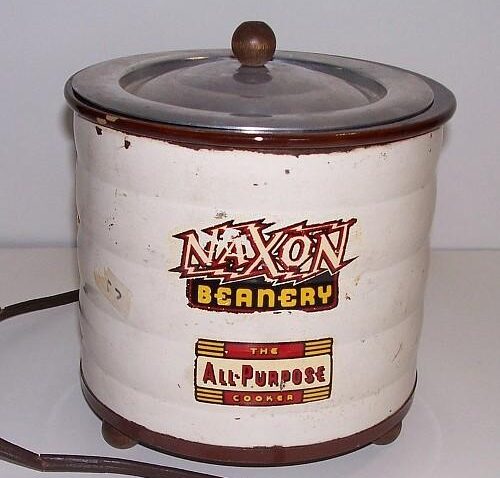
The first patent was issued in 1940 to Irving Naxon in 1940. But it wasn’t for the slow cooker as we know it today. Long before the Crock-Pot was a household name, the patent was for Boston Beanery or Naxon Beanery or the Flavor Crock and it was marketed to luncheonettes and coffee shops with a more specific purpose to use for making soups and chilis specifically.
Today’s versions produce not only soups and chilis, but roasts, savory stews and even moist breads and cakes.
Naxon’s slow cooker allowed families to prepare a meal without turning on the oven. The basic idea for the slow cooker was inspired by Naxon’s grandmother and a story she would tell about his great grandmother making CHOLENT back in Lithuania. Cholent is a traditional Jewish stew, a slow cooked meat, bean and barley stew served on the Sabbath that cooks unattended from before sundown on Friday to midday Saturday. Naxon wanted to create an appliance that would do all the work.
Dubbed the Beanery all-purpose cooker, a self contained ceramic crock with a heating element that ran at a low temperature with the contents left to simple simmer for hours. There was originally no removable insert or even a control switch. It was either plugged in and on or unplugged and off.
The “bean pot” never caught on large scale, so in 1970 Naxon sold his device to Rival Manufacturing. Rival was a Kansas City company already famous for kitchen gadgets like the Juice-O-Mat or the Knife-O-Mat sharpener. Rival was less than impressed with the original Beanery and gave it to their test kitchen personnel to see what they could do with it.
“No one paid any attention to it,” Rival president Isidore Miller told the Kansas City Times in 1981. “We almost forgot about it.” As the story goes, Miller handed the Beanery over to Rival’s test kitchen, where an employee named Marilyn Neill had an immediate epiphany: This can cook way more than just beans. Creating a freedom from kitchen duties. The tag line “Cooks All Day while The Cook’s Away” was embraced by working women everywhere for its ability to save time and money.
The test kitchen was able to create MANY recipes for the device that were both delicious and required minimal effort. This helped make it a BIG hit and the slow cooker was rebranded in 1971 as the Crock Pot and it was manufactured in Chicago, USA. This accomplishment also gave more attention to the accomplishments of the test kitchen. With that attention also came pressure to teach people how to use this new and novel small appliance as well as creating a book of successful comfort recipes for the soups, stews, roasts and other comforting old-fashioned food that would accompany each appliance. Multiple recipes were influenced by their midwestern origin. Flipping through 70’s cookbooks you’ll find recipes like steak soup, and brisket cooked low and slow or “Busy Woman’s” roast chicken that relied heavily on carrots and stove top stuffing, “Pork Chop Abracadabra” which relied heavily on a can of cream of mushroom soup or “Male Chauvinist Chili” which relied heavily on a trifecta of bacon, sausage, and ground beef. Other recipes centered ingredients you can’t find as easily today, nor would most people want to, like stuffed beef hearts and chicken livers.
Home economist, Mabel Hoffman contributed to the Crock-Pot craze when she published her cook book, rockery Cookery, in 1975. With over 250 recipes it was an instant best seller that she has revised over the years to changing palates.
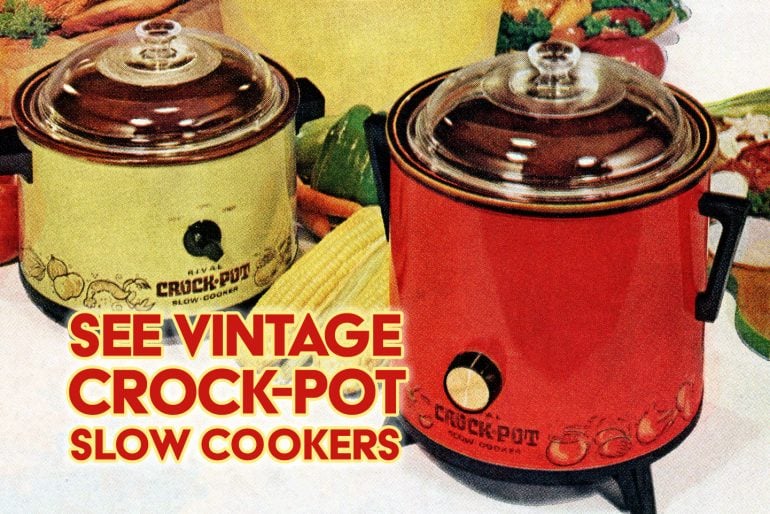
The renamed Crock-Pot made its official debut in 1971 at the National Housewares Show in Chicago. Offered in colors like avocado or harvest gold print ads and television commercials flaunted the Crock-Pot as a miraculous, time-saving device, assuring women in no uncertain terms that they could have it all. And the pitch worked with their sales hitting $2 million the first year it was introduced.
They didn’t stop trying to improve the design and in 1974 they made removable crocks for ease of cleaning. That next year sales reached even higher – $93 million.
In 1981 they were developing recipes that required more than just a piece of meat and a can of soup. Moore and Wyss loved developing recipes together, but they spent a majority of their time doing quality control and putting the Crock-Pot through its paces with Rival’s engineers. They also felt pressured do always do more!
Each day before they went home they would set up eight Crock-Pots with whole chickens and carefully measured-out proportions of carrots, onions and celery.
It was all very scientific. They’d leave the slow cookers overnight for the engineering department to watch over their temperatures and would come to work the next morning to evaluate those chickens to make sure that those pots were performing acceptable.
When the oil crisis hit the U.S. in the 1970’s, Americans were especially concerned about energy usage and turned to their slow cookers after learning that a crock pot took a mere 4 cents a day to operate, making it far more efficient than an oven. And, more importantly it was during this era that more and more women were working outside the home and Rival began marketing the Crock-Pot directly to them. The marketing plan worked. Women turned to the Crock-Pot to provide nutritious and affordable meals for their family that required minimal effort when they arrived home at the end of a long work day. To the working woman it was an easy, foolproof way to turn inexpensive, tough cuts of meat into more tender, long braised meals that also make the house smell great.
Moore and Wyss eventually left Rival Manufacturing, but they never stopped creating recipes together. They’re still in Kansas City — they just cook on their own terms now. The two women authored nearly 20 cookbooks together.
If you ask Moore and Wyss why the Crock-Pot endures today, they’ll tell you convenience plays a big part, but it’s not everything. The Crock-Pot has an emotional appeal, too — that feeling of coming home to a hearty meal, already simmering away. “I don’t think that any meal delivery or any of the frozen products can ever replace the aroma, the comfort, the emotion and the memories that come from a home-cooked meal,” Moore says.
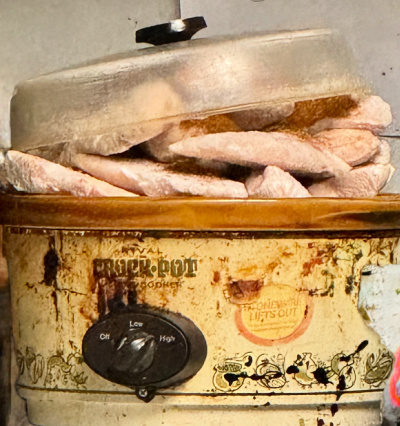
My girlfriend received one many years ago as a wedding present and she still uses it today in her business to prep for Taco Tuesday every week. I love how she plays Jenga with the frozen chicken 🙂