Aztec Chicken with Fresh Pico de Gallo

Oh yes, chicken again!!  Here’s a healthy meal full of fresh ingredients and tons of flavor!
 
I love finding new marinade for chicken.

Dress it up and you can have your chicken a million different ways!

I loved this way!

I devised this from several different recipes and it turned out really good!
I finally put my tomatoes and peppers to good use! I made a rockin’ pico de gallo!

I bought 2 tomato plants and 1 pepper plant this year. They have all been doing very well. But all I usually do with them is add them to quesadillas or salads.

This turned out great and I can’t wait to make it again!


Check out the Our Krazy Kitchen pals who have entries in Project Food Blog!  Please take a minute and vote for them!  Vote quick!  Polls close tomorrow the 23rd!

Dave – My Year on the Grill
Heather – Girlichef
Joanne – Eats Well With Others
Kristen – Frugal Antics of the Harried Homemaker
Min – The Bad Girl’s Kitchen

Aztec Chicken Recipe 

1 1/2 pounds boneless chicken
1 tablespoon oil
4 cloves of garlic
1 medium onion
3 tablespoon cilantro
1 tablespoon paprika
1 teaspoon cumin
1 teaspoon chili powder
1 teaspoon salt
1/2 teaspoon pepper

Combine oil, garlic, onion, cilantro, paprika, cumin, chili powder, salt and pepper in a food processor. Save a bit of the mixture for while cooking. Pour the rest into a large baggie with the chicken, mix and let marinade for a few hours.

Grill or pan fry chicken until done, brushing with reserved sauce. Serve with Pico de Gallo.

Rockin’ Pico de Gallo
1 pound tomatoes, chopped
1/2 cup onion, diced
1 jalapeno, diced
3-4 cloves garlic, minced or pressed
2 tablespoons lime juice
1/4 cup cilantro, chopped
Salt and pepper

Mix everything together and refrigerate until ready to use.

Total calories for chicken = 970 calories
Total calories for pico de gallo = 140 calories

6 servings = 185 calories per serving with pico de gallo

Aztec Chicken with Pico de gallo and Cilantro Rice = 456 calorie dinner

This makes a lot of Pico de gallo but I put a bunch on my rice too!

Check out the Cilantro Rice recipe on Debbi Does Dinner Healthy.

SO I HAVE A QUESTION????????????

Are you a Facebook fan? Do you play Facebook apps? Do you Twitter? Have blogs become passe’? This is a debate that some of my friends and family have been having or rather are having on an ongoing basis. Is you day being eaten up by computer time?

I ask all these questions because there seems to be a trend going on in the blog world. Comments appear to be disappearing all over the place. Participation in contests and memes appear to be diminishing.  Viruses are piggy backing on facebook apps and even google search engines. So is it because you are all glued to computer games or is it like any other journaling, it just loses its appeal after a while? Or is everyone out bar hopping and singing karoke? I’d love to hear what your take is?

aprons 3

And the Winner of the CSN gift certificate is………….

True Random Number Generator 
7 Powered by RANDOM.ORG

Just to remind you, CSN Stores has over 1 million products and that number is constantly rising. Not only is their product catalog growing but they’re adding new stores like www.luxebycsn.com. You can literally spend all day looking for the perfect product at CSN.stores.  Thank you CSN.stores for being so generous to the blogworld and allowing help spread the word.

Tammy will receive a $55 gift certificate to use
as she wishes at any of the 
CSN.stores websites.

Disclosure: I did not receive any type of compensation for this post. CSN stores is sponsoring this giveaway and will handle prize fulfillment. All opinions are my own and I was not influenced to post them.

PORK CHOPS MARSALA

Remember when I researched scampi?  And decided that scampi is not just for shrimp? Well, I got to thinking about how we get into cooking/eating ruts.  Are you in a rut?  We are sometimes even with me always trying new recipes.  I started analyzing the flavors we like and those we don’t.  Then I started wondering how I was going to transfers those like into new recipes.  I realized I don’t really need “new” recipes, I just need to “trade” out some ingredients.  This eventually led to me thinking about Chicken Marsala, one of our very favorite flavor combos. Adn that Marsala is not just for chicken.
To get you started here is a little Marsala history.

Marsala Wine Information
Marsala is the west section of Sicily, the island near the foot end of Italy. In 1798 the Sicilians managed to substitute their own wines in place of the standard rum in an English naval shipment. In those seafaring days, something had to be done to wine to allow it to last the long ocean journeys. Brandy was added to allow the wine to last longer, and to be more resistant to temperature changes. These were called “fortified wines”.

Once the British had a taste of Marsala, demand grew quickly. In the United States during Prohibition, things became even more interesting. The typical Marsala bottles made the wine look like medicine. People found that getting Marsala was less risky than other types of wine. While not as popular now, it is still used quite frequently as a cooking wine in Italian dishes.

Marsala uses the following grapes: 

  • white skin/berry grapes: Grillo, Catarratto, Inzolia and Damaschino for golden and amber Marsala
  • dark red skin/berry grapes: Pignatello, Calabrese, Nerello Mascalese, Nero d’Avola for ruby red 
Marsala is made in the “solera” tradition – a melding of years. First, a keg is filled with wine from the current vintage of grapes. Subsequent years with similar tastes are placed in kegs above the first. When liquid is drawn out of the bottom (oldest) keg, it is refreshed with liquid from the next keg up, and so on. In this manner, the taste remains the same throughout the cycle, and every bottle you get has (potentially) some liquid from the very first vintage.

Types of Marsala

    * Fine: 17° alcohol, aged >1 yr
    * Superiore: 18° alcohol, aged >2 years
    * Superiore Riserva: 18° alcohol, aged 4 years
    * Vergine Soleras: 18° alcohol, aged 5 years

Marsala was traditionally served between the first and second courses. It is now also served, chilled, with Parmesan (stravecchio), Gorgonzola, Roquefort and other, spicy cheeses.

Marsala Substitutions
I regularly get email from casual wine drinkers who come across a recipe for chicken marsala or veal marsala and want to know what other alcohol they can substitute instead. I *love* both of these dishes. Here’s the issue. Imagine you had a recipe for making orange juice and you wanted to substitute lemons instead. They’re both citrus! However they taste very different. So you’re no longer making orange juice, you’re making lemon juice now.

The same thing is true for dishes with marsala. It has a very specific dish. Sure, you could make chicken with chardonnay, or chicken with cabernet, and they might be tasty. But they are no longer chicken marsala. The flavor will be completely different. So at that point you could call it “chicken with wine” and be happy. If you want chicken marsala, then you need to find marsala, so that it tastes like marsala.

Pretty much any regular wine shop will have marsala bottles on their shelves, along with the port and sherry. Again marsala doesn’t taste like port and sherry 🙂 But that’s the type of wine it is. So I highly recommend that you take a run to your local wine shop, grab a bottle of marsala and enjoy! It lasts a long time because it’s fortified. Chicken and veal marsala are really yummy, so you’ll want to make it several times. It’s one of those staples of cooking, like having lemon juice in your fridge.

If you have serious issues with alcohol, I’m afraid there is not a non-alcoholic marsala flavoring. Note that any recipe calling for “Marsala” means this wine. Marsala is the name for this wine.

Sweet vs Dry Marsala
I get emails from cooks asking which they should use – sweet or dry marsala – in a recipe. It’s like saying you have a recipe which says to use cheddar cheese and you have mild cheddar and sharp cheddar and medium cheddar, and which should you use. You can use any of them. They are all cheddar, they will all provide a cheddar flavor. If you like mild cheddar better, you might go with that. But if you’re not a cheese fanatic you might not even really notice the subtle differences between for example mild and medium cheddar flavors when they are in a dish.

So it definitely is to taste 🙂 Do you like sweetish chicken dishes? Do you like non-sweetish chicken dishes? Are you even going to notice the difference which is that kind of subtle variation? Who knows, you might not even be able to taste any difference since both are going to taste “like marsala”. Undoubtedly you’re not going to make chicken or veal marsala only once in your life if you like it, you’ll make it every few weeks. So make it one time with the sweet and one time with the dry, and see if you can even notice any difference. Or, I suppose, have someone else add in the marsala and not tell you which they used and see if you can guess 🙂 It might be you can’t even tell which is being used, in which case it’s not worth worrying about. Use whichever one you have more of.

Storing Marsala
Marsala is a fortified wine – this means they add hard alcohol to it. This also means that, just like you can keep opened (sealed) bottles of vodka and rum on your shelves, you can also keep an opened bottle of marsala around. Yes, the flavor will gently deteriorate over time, but it won’t go from wonderful tasting to awful tasting in three days. You probably won’t even notice the flavor difference after a month or two. Still, I’d suggest drinking it all within three to four months (or cooking dishes with it). When you cook with a flavor, you get a really concentrated version of that flavor. So you want really tasty, yummy marsala flavors – not sort of stale, stagnant marsala flavors. I am very much a fan of eating food that you really enjoy, and savoring the flavors!

Marsala is fortified, so you do NOT have to store it in a fridge or take any special measures. Just keep it in a cool, dark area like any other oil or wine. Marsala will not “go bad” – it won’t turn dangerous to drink – but its flavors will fade over time.

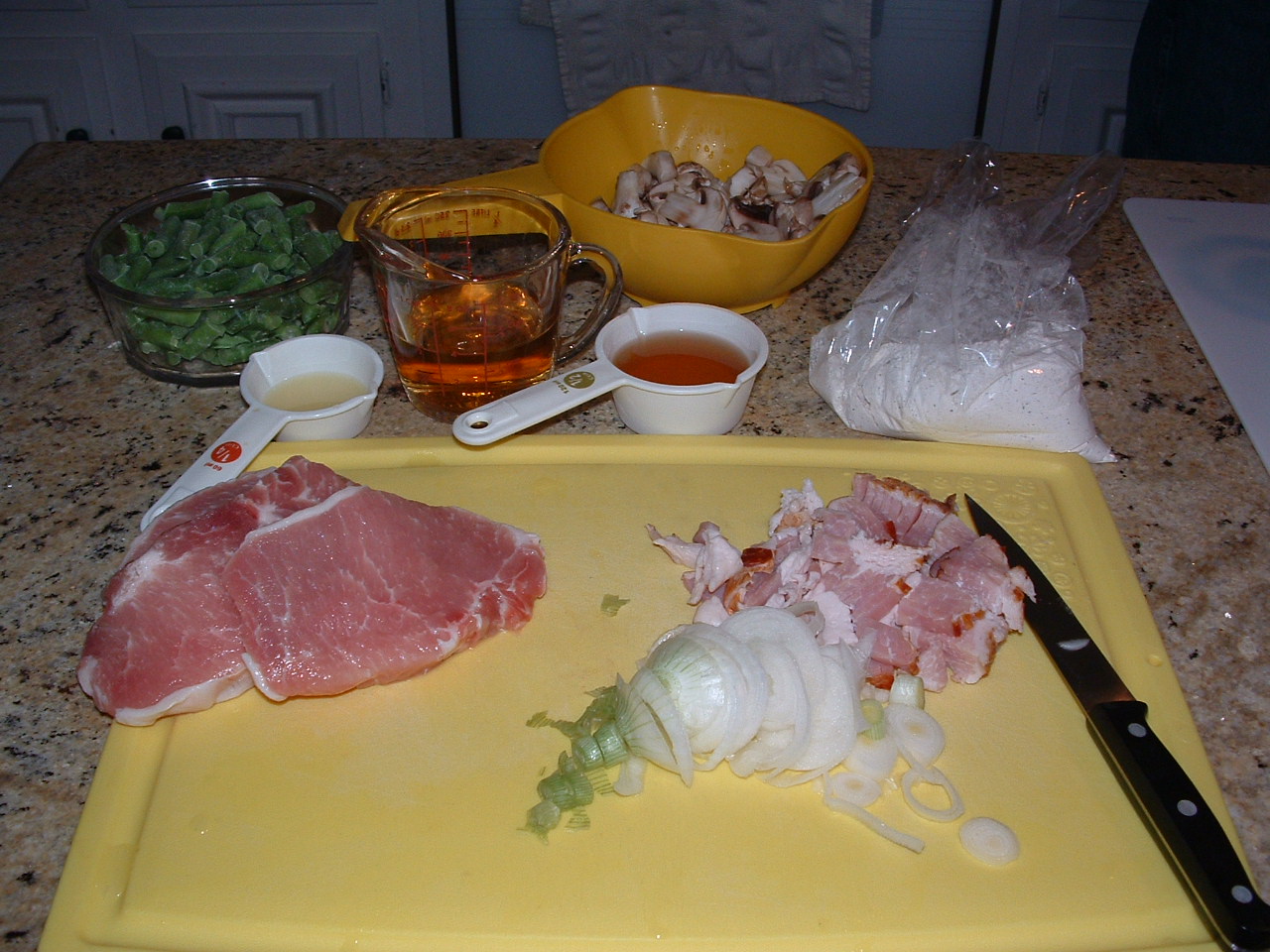
PORK CHOPS Marsala

  • 1/4 cup all-purpose flour
  • 1/2 teaspoon sea salt
  • 1/4 teaspoon ground white pepper
  • 1/2 teaspoon dried oregano
  • 4 boneless pork chops – 1/4-1/2  inch thick
  • 2 slices thick bacon, diced
  • 4 tablespoons butter
  • 1 small white onion
  • 2 cups frozen green beans
  • 1 cup sliced mushrooms
  • 1 tablespoon lemon juice
  • 1/2 cup Marsala wine
  • 1/4 cup sweet cooking sherry
  1. With a mortar and pestle grind the oregano. Sift together the flour, salt, pepper and oregano. Coat the chicken pieces well.
  2. In a heavy skillet, heat butter. Add the bacon pieces and stir fry for several minutes.  Slice onion into rings and separate. When butter is hot, saute’ onions until just caramelized.  Add the mushrooms and green beans and saute until cooked through. Set aside and place pork chops in skillet and brown on both sides about 5 minutes per side over medium heat. Remove and set aside.
  3. To the skillet, add the wine, lemon juice and sherry. Stir, reduce heat, and cook for about 10 minutes until the sauce is partially reduced and begins to thicken. Return chicken breasts to the skillet. Spoon sauce over the chicken. Cover and cook over low heat for about 5-10 minutes or until chicken is done.

Save Room for Dessert…Cinnamon Mocha Pie with Orange Essence Whipped Cream

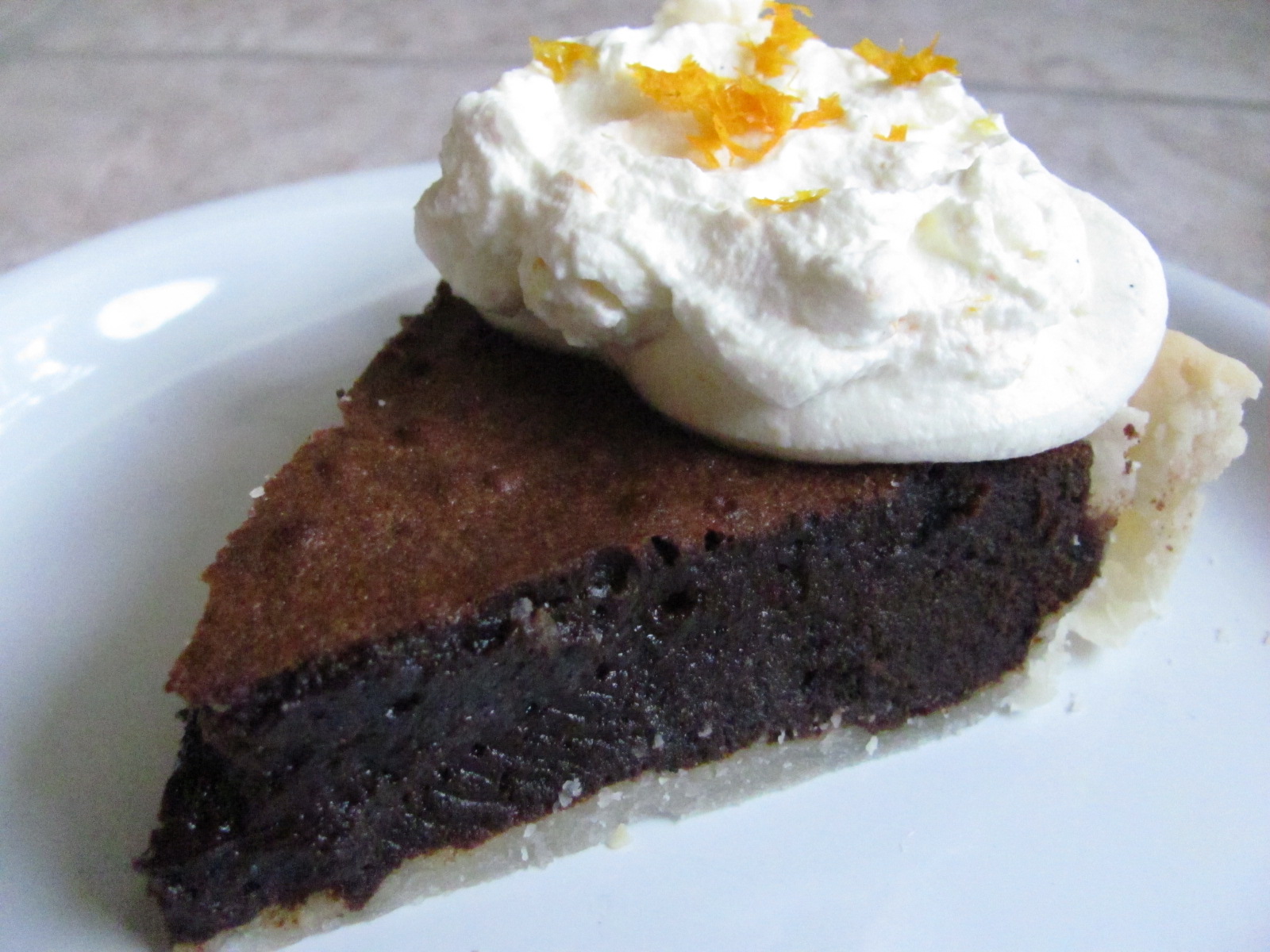
Last week, I took the non-chocolate route with raspberry pecan crumble bars.  So, I definitely thought it was time for chocolate again, yes?  The recipe is from Christmas with Southern Living 2003.  This pie has always been one of my favorites, as I adore all things chocolate, and with the addition of coffee and whipped cream, well, it’s a win-win!  My little twist is the orange flavor added to the whipped cream; it’s certainly optional, but oh so delicious! This pie is sheer indulgence.  There is no other way to describe it.  Dense with fudgey chocolate flavor.  Heady with the fragrance of cinnamon.  Luxuriously sinful with a dollop of whipped cream that’s just kissed with a hint of orange.  And, best of all, deceptively simple…enjoy!

Cinnamon Mocha Pie
1/2 cup unsalted butter
1 tablespoon instant coffee
2 oz unsweetened chocolate squares, chopped
2 oz semi-sweet chocolate squares, chopped
3 large eggs
3/4 cup granulated sugar
1/4 cup brown sugar
1 teaspoon vanilla extract
1/3 cup flour
1 tablespoon ground cinnamon
1 recipe all butter pastry, fitted into 9″ pie pan
1 cup whipping cream
1 tablespoon orange zest, plus extra for garnish
1 tablespoons orange juice
2 tablespoons powdered sugar

Prepare pastry and place pan into freezer while you prepare the filling.
Preheat oven to 350 degrees.
In a small saucepan over medium-low heat, melt butter and add instant coffee.  Stir in the chopped chocolate and continue to stir until chocolate is melted and the mixture is smooth.  Remove from heat, set aside, and allow to cool.
In another bowl, beat eggs and sugars until slightly frothy.  Add cooled chocolate and vanilla.  Stir in flour and cinnamon.  Pour mixture into prepared pie shell.
Bake at 350 degrees for 25 minutes or until filling sets.  Allow pie to cool to room temperature (the pie will cut better) and serve with whipped cream and a dusting of orange zest.

Whipped Cream with Orange Essence
Whip cream until soft peaks form.
Add 1 tablespoon zest, juice, and powdered sugar.
Continue to beat until firm peaks form.
Use immediately.

Adapted from Christmas with Southern Living 2003

CHICKEN MARSALA

Chicken Marsala

  • 1/4 cup all-purpose flour
  • 1/2 teaspoon sea salt
  • 1/4 teaspoon ground white pepper
  • 1/2 teaspoon dried oregano
  • 4 skinless, boneless chicken breast halves – pounded 1/4 inch thick
  • 4 tablespoons butter
  • 4 tablespoons olive oil
  • 1 small white onion, sliced into thin rings and then separated
  • 1/2 pound mushrooms, sliced thin
  • 1 tablespoon lemon juice
  • 1/2 cup Marsala wine
  • 1/4 cup sweet cooking sherry
  1. With a mortar and pestle grind the oregano. 
  2. Sift together the flour, salt, pepper and oregano. 
  3. Coat the chicken pieces well with the flour mixture.
  4. In a heavy skillet, heat oil and butter.  
  5. When oil and butter is hot, saute’ onions and mushrooms until just caramelized. 
  6. Set aside onions and mushrooms and place chicken breasts in skillet and brown on both sides about 6 minutes per side over medium heat. Remove and set aside, but keep warm.
  7. To the skillet, add the wine, lemon juice and sherry. Stir, reduce heat, and cook for about 10 minutes until the sauce is partially reduced and begins to thicken.
  8. Return onions and mushrooms to the skillet. 
  9. Plate chicken breasts.
  10. Spoon sauce over the chicken.
  11. Cover and cook over low heat for about 5-10 minutes or until chicken is done.

aprons 3

ARE YOU READY FOR SOME FOOTBALL????????????

We are – we’re HUGE fans!  We do a count down in August to pre-season every year and never miss a game when at all humanly possible!  Well, it’s that time of year again! Football season is already 1 week old and that means it’s time for tailgating at the games, serious football food and game day buffets.  Bring over your best appetizers and your biggest appetite and oh don’t forget the Brewskis to go with it all.  I like mine really cold please with a side of lime!
Tailgating Time will be posted every Sunday at noon and open all week for you to add your football favorites. We’ll play each and every week until Superbowl Sunday. I can’t wait to see what you’ll be bringing!
It’s Tailgating Time!
HOSTED BY:
Martha at Seaside Simplicity 
Tamy at 3 sides of Crazy 
Lyndsey at Tiny Skillet
Would you like to be a host of Tailgating Time too? 
Leave me a comment here with your email or with Martha over at Seaside Simplicity so we can send you the code and add you to the host list – more exposure, more links, more football food!
And don’t forget today is the last day to enter the $55 CSN giveaway here at 3 Sides of Crazy.  
Today is the first day to enter the $65 CSN giveaway over at Seaside Simplicity.  You  have to go to http://www.allcoffeetables.com/ and then come back either here or over at Seaside Simplicity and leave a comment saying which one is your favorite AND then link up a recipe to Tailgating Times. You are only eligible to win if you do both.  The winner will be announced at next week’s tailgating time.

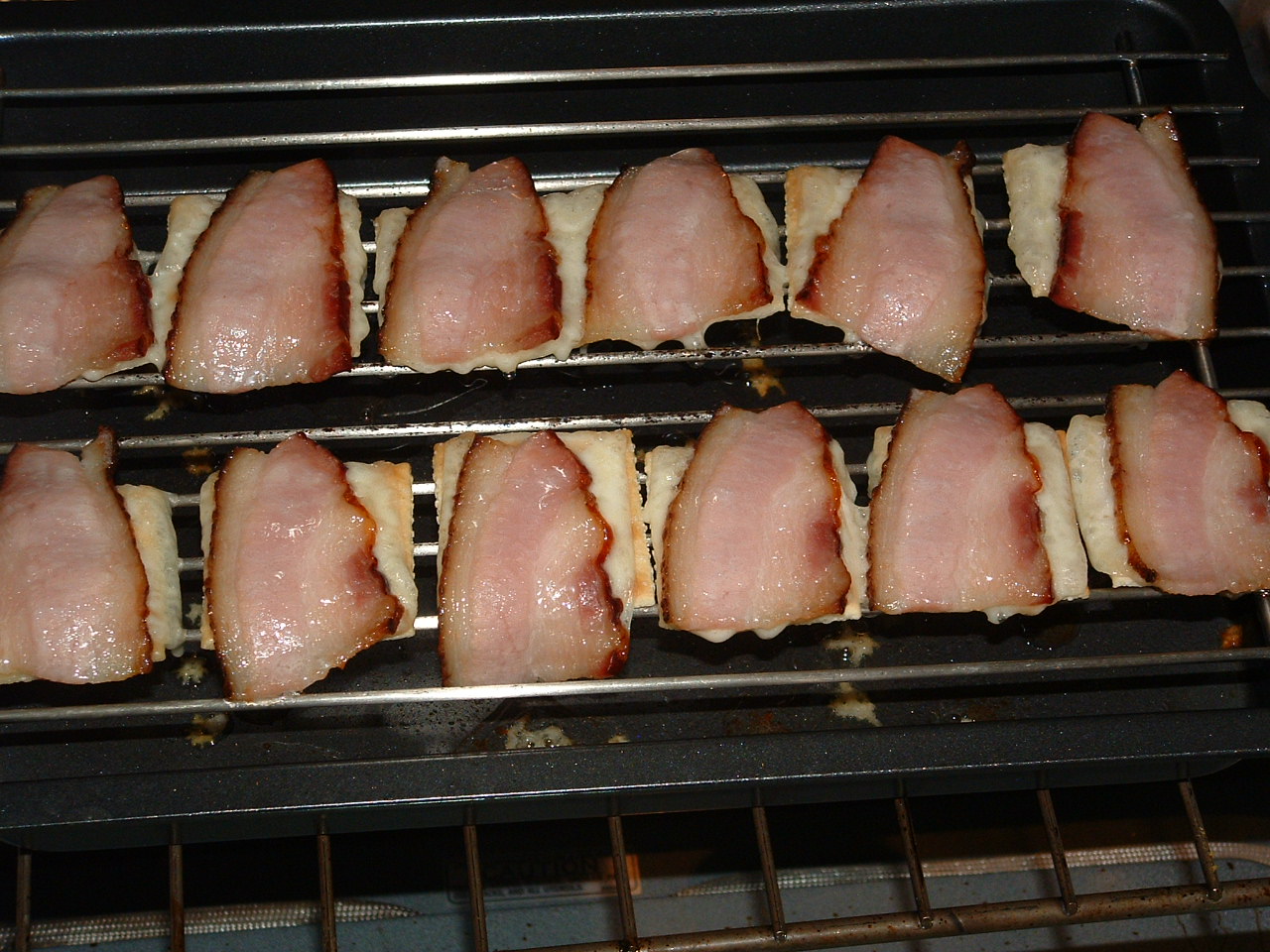
SALTY BACON CRISPS ~ Perfect Football Food Snacks

SALTY BACON CRISPS
12 bacon strips, cut in half*
6 slices Havarti or aged white American cheese, cut into quarters
24 saltine crackers
  • Top each cracker with a slice of cheese.
  • Wrap each cracker with a half strip of bacon.
  • Place on a cookie rack over a shallow drip pan.
  • *Bake 12 to 15 minutes, turning once, at 400° F.
  • Serve hot.

*I used thick bacon today and quartered each slice.  Then I laid it just on top and I prefer this I think.  Thick bacon does alter the bacon time to 15-20 minutes. 

They were soooooooooooo easy and tasty too.  The crackers soften up and absorb the cheese and bacon flavors.  Let them cool just a bit and they are perfect!

    WEEKLY MENU

    Menu Plan Monday hosted by Laura at I’m an Organizing Junkie

    DATE breakfast lunch supper
    MON 9/20


    CHICKEN SPAGHETTI
    TUES
    9/21

    RECIPE EXPERIMENT NIGHT ~ REDNECK CUPCAKES WAR ~ BBQ CHICKEN CHILE CORNBREAD REDNECK MUFFINS
    WED 9/22

    chinese chicken salad
    THU
    9/23

    chicken posole
    FRI
    9/24


    Stacked Green Chile & Grilled Chicken Enchiladas
    SAT
    9/25
    EGGS ala ROOSEVELT aka DEPRESSION EGGS leftovers SEAFOOD CASSEROLE EXTRAORDINAIRE
    SUN
    9/26
    swedish pancakes with lingonberries Pete & Shorty’s twisted pepper steak in gravy

    aprons 3

    The Daring Cooks September, 2010 Challenge: FOOD PRESERVATION-THE APPLE BUTTER OF KNOWLEDGE

    I’ve been canning since I was a teenager and have entered many county fairs with my jams and preserves.  I even have some 1st place wins at the LA County Fair and I’ve taught seniors to can in church programs, but I still relished this challenge.  There are so many variables in canning, that every new batch is a challenge.
    Apple butter is essentially an apple sauce that’s been cooked down with spices to form a thick spread. No “real” butter is used in the making of apple butter. “Butter” just refers to the spreadable consistency of the final product.
    Apple butter is actually a very simple recipe, so please do not be discouraged by the information and jargon used in this write-up. 
    Why Preserve Foods?
    There are many reasons – save the harvest from our garden for later in the year, control the ingredients that go into our food, nostalgia (memories of our parents or grandparents), make gifts, satisfaction of making it yourself… etc. For me, it’s curiosity, controlling what I eat and just the satisfaction of making it myself.
    Why foods go bad?
    Before we start preserving foods, we need to know why foods spoil.
    The two main culprits are:
    1) The obvious culprit is bacteria, molds and yeast/fungi. I call them “bad bugs.” There are “good bugs” that help with fermentation (yogurt, beer, wine, sourdough breads and pickles), but the bad bugs rots foods, gives foods an off taste and can make us sick.
    2) The other culprit is enzymes. Enzymes are molecules that occur naturally in food which encourage chemical changes, some of which are desirable – help ripen fruit by converting starch to sugar, soften fruits or vegetables, or reduce acidity level. Some changes are not desirable, browning when an apple is cut, or the fruit becomes overripe where the flesh becomes soft and mushy.
    The other supporting culprits are oxygen and unintentional moisture loss. Fortunately, when we eliminate microorganisms, the rest of the culprits are taken care off at the same time.
    Brief summary of how each food preservation method works.
    Preservation Method Acid Temperature Oxygen Moisture
    Freezing   Storing foods at 0F (-17.8C) or lower Airtight packaging  
    Boiling Water Canner (high acid foods)/Pressure Canner (low acid ) Some foods can be acidified using vinegar or lemon juice Heats foods to kill bad bugs and neutralize enzymes Jars form a vacuum seal – creates a low oxygen environment
    Pickling and Fermentation Food is acidified by using vinegar or natural bacteria creating lactic acid     Brines (salted water) and sugars reduce fresh water
    Drying Airtight packaging Removes up to 90% of the moisture
    Jam and Jellies Vinegar or Lemon juice, Fruits naturally acidic Cooking, canning or Freezing Canning will create a vacuum seal Sugar reduces water available
    For this daring challenge, we will be focusing on Freezing and Boiling Water Canning.
    Freezing:
    Freezing refers to storing foods in airtight containers at 0ºF (-17.8ºC) or lower. Freezing does not kill bad bugs. The cold temperature causes the microorganisms to go into hibernation/suspended animation.
    Freezing is the easiest food preservation method, especially with modern freezers.
    The main pointers for freezing:
    • Freeze foods quickly. Quickly freezing creates smaller ice crystals. Water is a funny substance where water expands when frozen. This means larger ice crystals can puncture cell walls (such as whole berries) so when defrosted you end up with a mushy mass.
    • Try not to freeze too much at once. Typical advice 2 to 3 lbs (1 kg) per cubic foot (28 Liters) of freezer space.
    • Containers should be airtight and leak proof.
    • Minimize air and gaps in the packaging. This reduces the chance for freezer burn – drying.
    • Label and date the package. Frozen foods tend to look the same over time, especially when a layer of ice has formed.
    • Vegetables can be blanched to deactivate enzymes. Blanching is quick cooking in boiling water for a few minutes and cooled rapidly in ice water.
    • For initial freezing using pliable freezer bags, freeze on a smooth, flat surface to prevent the bag from molding itself to the rack.
    Boiling Water Canning:
    Boiling water canning sterilizes the food using the temperature of boiling water. The jars form a vacuum seal which creates a low air/oxygen environment.
    Important!
    The temperature that water boils varies with altitude. At sea level, water boils at 212ºF (100ºC) while at 5,000 ft (1524 m) water boils at 203ºF (95ºC). What this means is canning (processing) times increase with altitude. Fortunately, we don’t need to do the math. Canning recipes include processing times for different altitudes.
    Boiling water canning is appropriate for high acid foods (foods with pH values lower than 4.6). Typically, fruits are high acid foods while vegetables are low acid. There are a few fruits that are on the border (pH 4.6), such as, tomatoes. However, some borderline pH foods can be acidified by adding vinegar or lemon juice. In home canning, lemon juice (and lime juice) refer to bottled concentrate, unless the recipe calls for fresh. Also, vinegar refers to vinegar with 5% acidity. The percentage strength can be found on the label.
    In the USA, home canning uses Mason jars, a thick-walled jar. The lid is a two piece assembly – the lid with a reddish sealing compound and a metal band/ring.
    Jars should be inspected before each use – looking for cracks and chips. Washed with detergent dish soap and dried. To reduce thermal shock (hot food cracking a cold jar), the jars should be kept hot. Clean jars can be kept hot by submerging in the boiling water canner or in a dishwasher. Also, a warm oven can be used.
    For processing (canning) times less than 10 minutes, the jars need to be sterilized for 10 minutes in boiling water. For altitudes higher than a 1,000 ft (305 meters), an additional minute is added for each 1,000 ft (305 meters) above sea level.
    The basic steps for using a boiling water canning. 
    • Check your jars for chips, cracks and nicks. Wash and preheat your jars.
    • Fill you canner half full with water. Preheat water to 140ºF (60ºC) for raw packing foods or 180ºF (82ºC) for hot packing foods.
    • Fill jars with food prepared according to the recipe, remove bubbles and adjust headspace.
    • Load jars into the canner. It’s important to keep the jars level.
    • Add more hot water, as needed, so the jars are submerged by at least 1 inch (2.54 cm) of water.
    • Cover the canner with the lid and turn the heat to high.
    • Set timer when the water comes to a vigorous boil. You can lower the heat, but the boil must be maintained.
    • When the time is up, turn off the heat and remove the lid. Wait 5 more minutes.
    • Remove jars making sure the jars are level and set on a towel. Allow to cool to room temperature, undisturbed for 12 to 24 hours.
    Terminology
    • Headspace – is the gap between the top of the container to the level of the liquid or food. For freezing, headspace is important to ensure there is room in the container for the expanding food. For canning, headspace ensures that a proper vacuum seal will form without the food spilling out of the jars while canning. 
    • Raw Pack (canning) – foods are placed in jars raw and, typically, a flavored liquid is added to the jars before processing. Advantages: Food is not cooked twice. Retains shape better. Disadvantages: Uses more jars. Foods may float due to trapped air. 
    • Hot Pack (canning) – foods are cooked before jarring. Advantages: Foods are cooked down so more can be packed into a jar. Less air in food. Disadvantages: Original shape is lost.
    Recipe: Reduced Sugar Apple Butter
    Ingredient U.S. Metric Count Special Instructions
    Apples 4lbs* 1.8 kg 12 Apples Cut into eights, stem and blossom end removed
    Apple Cider 1 Cup 240 ml   Optional: Water or Juice
    Sucralose/Splenda 1/2 Cup 120 ml   Optional: Honey, Agave or Sugar – to taste
    Cinnamon, Ground 1 Tbl 15 ml    
    Allspice, Ground 1/2 tsp 3 ml    
    Cloves, Ground 1/4 tsp 2 ml    
    Note: * If you used peeled and cored apples. I recommend buying 5 lbs (2.26 kg) of apples.
    Gala and Golden Delicious Apples
    Directions:
    • Wash apples well and remove stems. Cut apples into quarters or eighths and remove cores.  Note: I ended up peeling the apple at this step.
    • Combine unpeeled apples and cider in 8-quart (about 7 ½ litre) saucepan. Cook slowly and stir occasionally to prevent sticking. Cook until apples are very soft (falling apart).
    • Position a food mill or strainer securely over a large bowl. Press cooked apples with cider through the food mill or strainer to make a pulp. Be sure to collect all the pulp that comes through the food mill or strainer; for example, scrape any pulp clinging under the food mill into the bowl.  Note: Since the apples were peeled, I just mashed in the pot.
    • Combine pulp with Sucralose and spices in an 8-quart (about 7 ½ litre) saucepan. Simmer over low heat, stirring frequently. Note: A stick blender was used to mix the spices and creates a smoother apple butter. Also, when cooking down the apples, you want to leave the lid ajar or use a splatter screen. This will allow for evaporation. Another trick is to support the lid by laying two wooden spoons across the top of the pot.
    • To test for doneness, spoon a small quantity onto a clean plate; when the butter mounds on the plate without liquid separating around the edge of the butter, it is ready for processing. Another way to test for doneness is to remove a spoonful of the cooked butter on a spoon and hold it away from steam for 2 minutes. It is done if the butter remains mounded on the spoon.  Note: It may be difficult to see, but the sample on the left is the apples sauce from step 3. The apple sauce left a liquid ring while the apple butter did not.
    • Pour contents into desired storage container or multiple containers. I stored my apple butter in 1-cup (250ml) plastic containers with screw on tops. Refrigerate up to 2 weeks, freeze up to a year, and home canning is good for a year.
    * The Finished Apple Butter:
    Apple Butter is often used as a spread. However, apple butter can also be used as a condiment (pork chops or in marinades) or as an ingredient to an apple quick bread.

    * Freezing:
    I used a freezer bag where I expelled as much air as possible and minimized the gaps in the bag. Freezer bags work well for storage since they can lay flatter in the freezer than containers.

    With a container, you need to ensure you have “headspace”. Headspace is the gap between the food (or liquid level) and the top of the container. Typical, headspace when freezing foods is 1/2 “ (1.27 cm) for straight sided containers. As mentioned previously, water expands when freezing. The headspace allows room for expansion.

    Thawing:  
    The best method (Food Safety) is to thaw in the refrigerator for a day.
    Cold water, 70ºF (21ºC) or lower, can be used for as quicker way to defrost. The frozen food is submerged under running water. An alternative to running water is to change the water every 30 minutes. If you need an even faster method to defrost and you plan to cook the food immediately, the microwave is another method (of last resort).
    * Boiling Water Canning:
    For our challenge, apples are high acid foods. Golden delicious apples have an approximate pH of 3.6. Boiling Water Canning is an appropriate method of preserving apple butter.
    Apple Butter processing information:
    Headspace when canning apple butter is 1/4 “ (0.64 cm)
    Processing Time:
    15 minutes for altitude of 0 ft (0 m) to 1,000 ft (305 m)
    20 minutes for altitude of 1,001 ft (305.1 m) to 6,000 ft (1828.8 m)
    25 minutes altitudes above 6,000 ft (1828.8 m)
    For boiling water canning, you need a pot that is high enough to cover the jars with at least 1” (2.5 cm) of water. Also, a rack, to prevent thermal shock, is used to keep the jars off the bottom of the pot. Any type of rack will work – a tea towel, a trivet, tying together unused bands… etc. I improvised a rack by tying metal bands to a bamboo sushi mat.  
    • Jars are filled using a wide mouth funnel. 
    • A plastic bubble remover is run along the sides of the jar, in an up and down motion, to remove air pockets.
    • The top and side of the jar are wiped down with a damp paper towel.
    • Headspace is measured to ¼” (6.5mm).
    • Lids are placed in a pan of hot water (180ºF or 82ºC) to soften the sealing compound. Do this prior to beginning to fill your jars so it sits in the hot water about 10 minutes.
    • The lid is seated, centered on the jar and the band is screwed on.
    • The purpose of the band is to hold the lid down, but not too tightly. Air from the jar needs to escape into the boiling water.  I generally screw down the bands (using two fingers) until resistance stops the band. After which, I give a slight additional 1/4″ (6.5mm) twist.
    • The jars are lowered into the hot water canner. Water temperature is about 180ºF (82.2ºC).
    • The water level is checked to ensure there is at least 1” (2.54 cm) of water above the jars.
    • Next, pot is covered and heat turned to high.
    • When the water comes to a boil, the timer is started (15 minutes). The heat can be lowered as long as the water remains at a boil.
    • After the 15 minutes are up, the whole canner is removed off the burner (I have an electric stove) and uncovered. Jars are left in the canner for 5 more minutes.
    • After 5 minutes, the jars are lifted out level.  The temptation is to tilt the jars to drain the water off the top of the lids. Do NOT do that! You don’t want to contents of the jar to running under the seal.
    • Jars are placed on a dish towel to minimize thermal shock and allowed to cool for 12 to 24 hours. While the jars are cooling, you may hear a ping or a pop from the lid as it seals. That ping is a good sound. For these three jars, they all pinged within a minute.
    • After 24 hours, test the seal. The lid should be bowed down (concave), when you press down the lid should not move or pop up. Also, try lifting the jar by the lid only. The lid should stay on if properly sealed. The final thing is to look at the lid to see if there are any cracks or debris caught between the jar and the lid.
    Storing – Once the integrity of the lids have been checked, it’s best to store the jars in a cool, dark space. The rings are removed. The rings have done their job of holding down the lids in the boiling water canner and are not needed for storage.

    Remember to check the lid before you open a jar.
    If the lid has become unsealed during storage or the lid is bulging, throw it out.
    If the food has mold, become oddly discolored or has an off odor, throw it out.
    The canned apple butter can easily store on a shelf for one year.

    aprons 3